

Francisco de Goya y Lucientes (Fuendetodos, 1746 – Bordeaux, 1826), besides being the most important painter of his time, was an excellent engraver, comparable to Rembrandt. Los Caprichos is not the first chalcographic series created by the painter. However, it is the first series conceived as a complete, closed unit. Between 1778 and 1779, he had already made some initial attempts in this discipline with a series of engravings inspired by the work of Velázquez. Upon concluding his second trip to Andalusia in 1797, he returned home with the idea of executing a new series of prints, the nature of which was already beginning to show in his sketchbooks (Sanlúcar Album A, 1796-97, and Madrid Album B, begun in Andalusia) through bitter and critical notes and sketches, particularly in the second album, created after his break with the Duchess of Alba. His deafness had worsened significantly of late, leaving the artist isolated and introspective. A large portion of these drawings, marked by cynical and biting irony, served as the source of inspiration for Los Caprichos, which were published in 1799. In 1803 Goya offered the original plates to King Charles IV, who deposited them at the Royal Chalcography. Today they are preserved, worn from use, at the Real Academia de Bellas Artes de San Fernando in Madrid.
In this series, Goya portrays the collapse of the human being. He reflects a social and political world in crisis, stagnant, based on a petrified stratification by estates, and anchored in immobilism. Goya was a thoroughgoing Enlightenment thinker in the manner of Jovellanos and Moratín, and from his fiercely liberal perspective, he castigates everything he perceives as obscurantism linked to decadent absolutism. Yet his critique transcends the immediate anecdote of the moment to become a condemnation of all universal fanaticism across time and space. Hence the enduring relevance of his biting wit.
The Abbey of Montserrat preserves a total of 42 prints from the 80 that comprise the complete series. They entered the collection in 1964 as a donation from the Paris antiquarian bookseller Just Cabot. All of them belong to a late edition, likely that of 1868, produced using the original plates, although by then considerably worn.
Goya's Caprichos immediately caught the public's attention, and explanations were promptly demanded. Several manuscripts commenting on the prints originated from Goya himself and his closest circle. The main ones are those from the Museo del Prado, the Biblioteca Nacional in Madrid, and the manuscript once owned by López Ayala—the Prado manuscript being consistently more moderate in its commentary than the others.
The numbering corresponds to the order of the Montserrat series, while the numbering in parentheses is that of the first edition from 1821. We have retained the original Spanish spelling of both the prints and the commentaries.
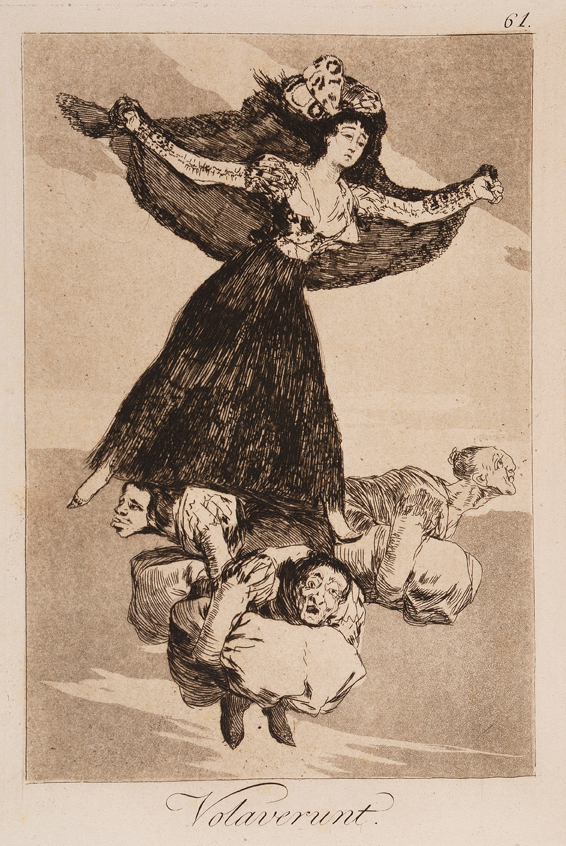
Aguafuerte y aguatinta y punta seca, 15 x 21,5 cm
El artista quiere ironizar sobre la volubilidad de los sentimientos femeninos y la inconstancia ante los compromisos amorosos. Es casi opinión unánime que la figura de la damisela es el retrato de la Duquesa de Alba, como indican los comentarios de los manuscritos de la Biblioteca Nacional y el de Ayala. La fémina extiende los brazos con el chal haciendo el gesto de volar, mientras es llevada por el aire por tres brujas y luce como ornamento en la cabeza las enormes alas de una mariposa. Dicen que cuando unos indiscretos preguntaban al artista, ya viejo, sobre sus amores con la bella aristócrata, él contestaba lacónicamente: “Volaverunt”. El manuscrito del Prado dice: “Hay cabezas tan llenas de gas inflamable que no necesitan para volar ni globo ni brujas.”
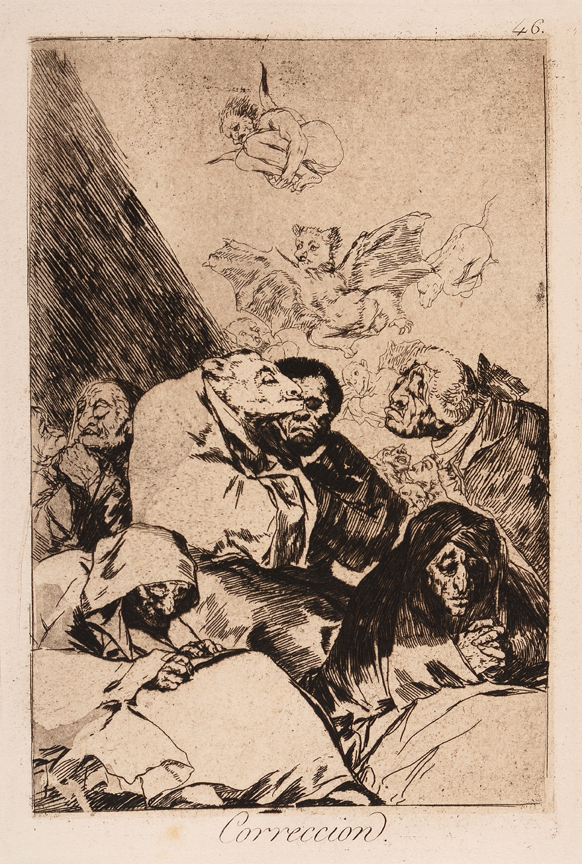
Etching and aquatint, 15 x 21,5 cm.
This stamp belongs also belongs to the many that handle the witchcraft theme. We see incubus or succubus demons that flies behind the friars, devotes and witches group, that demonstrate a submissive attitude to irrationality. The Prado’s manuscript says: “Sin corrección ni censura no se adelanta en ninguna facultad y la de la Brugería necesita particular talento, aplicación, edad madura, sumisión y docilidad a los consejos del Gran Brujo que dirige el seminario de Barahona.” (Translation: without correction or censorship, no progress is made on any faculty and that of witchcraft needs particular talent, application, mature edge, submission and docility to the advides of the Big Wizard who manages the Barahona’s seminary). The Biblioteca Nacional manuscript, instead, quote to “los pícaros de todos los estados y condiciones, mercaderes, frailes y villanos que aparentan propósito de enmienda cuando les predica un mono cualquiera.” (Translation: the rogue of all states and conditions, merchants, friars and villains who appears purpose of amendment when any monkey preached to them).
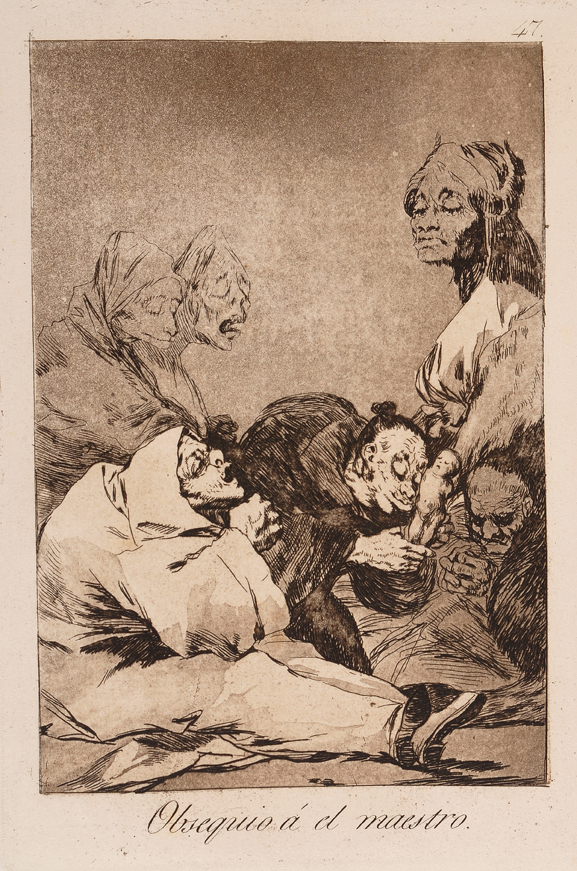
Etching, aquatint and burin, 15 x 21,5 cm
We find ourselves in the same situation as with the last stamp. The superstitious and fanatical convictions promote submissive attitudes to the power, that they apply to her teacher and master, which is none other than the demon, like we see in the stamp with his twisted horns. The Prado’s manuscript says: "Es muy justo: serían discípulos ingratos si no visitaran a su catedrático a quien deben todo lo que saben en su diabólica facultad.” (Translation: “Es muy justo: serían discípulos ingratos si no visitaran a su catedrático a quien deben todo lo que saben en su diabólica facultad” (Translation: they would be ungrateful disciples if they didn’t visit their professorial to whom they owe everything they know in his diabolical faculty). Considering the friar figure in first term and the theatrical devout attitudes, the manuscript comments of Biblioteca Nacional and Ayala’s remark the anticlerical aspect of the stamp.
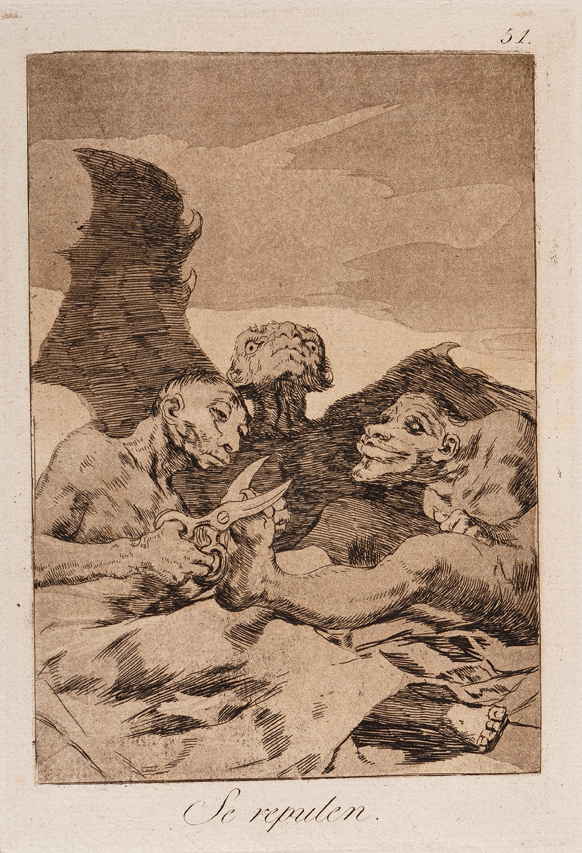
Etching, aquatint and burin, 15 x 21,5 cm.
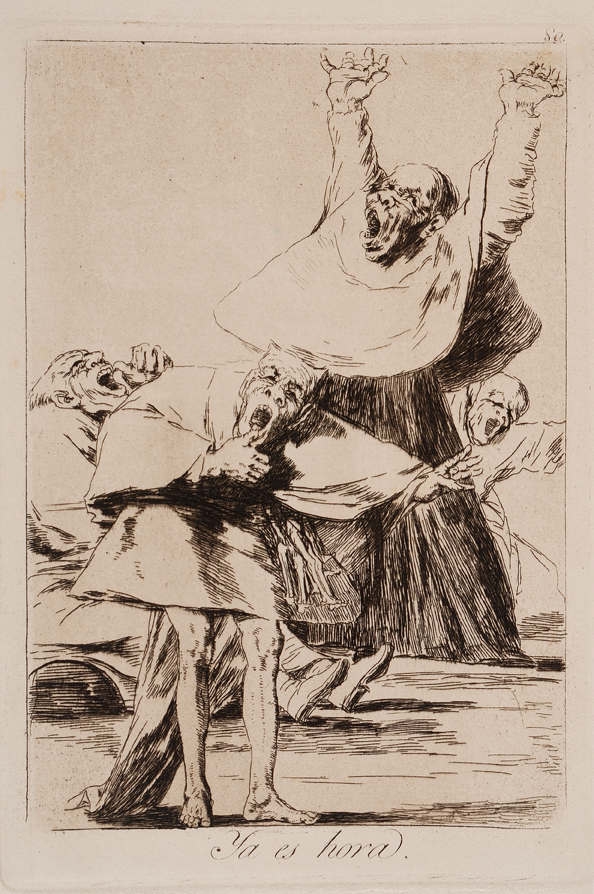
This stamp is about a theme very related to the Black Spain and very actual. The nails evoke rapacity. The robbers of any condition help each other and cover up the antics, like the Big Wizard do, in the center, spreading his wings, which also have predatory nails. The Biblioteca Nacional manuscript says: “Los empleados que roban al estado se ayudan y sostienen unos a otros. El Gefe de ellos levanta erguido su cuello y hace sombra con sus alas monstruosas.” (Translate: The employees who steal the State help and hold each other. His boss lifts his neck and does shadows with his monstrous wings). The Prado’s manuscript, like usually do, is more cautious in his comment: “Esto de tener la uñas largas es tan perjudicial que aun en la Bruxería está prohivido.” (Translation: Having long nails is so damaging that even in witchcraft it’s forbidden).
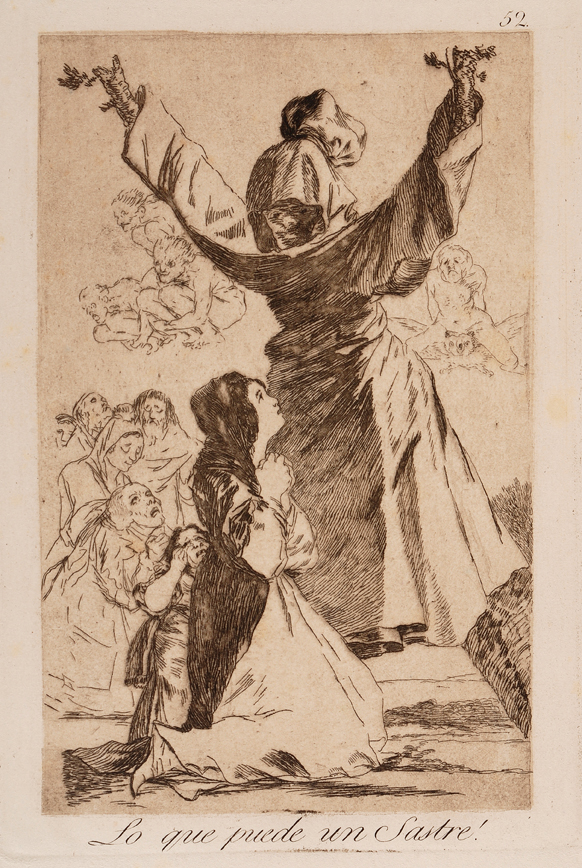
Etching and aquatint, drypoint and burin, 15 x 21,5 cm.
Again Goya injuries and laughs of the irrationality and the popular superstition. The Biblioteca Nacional manuscript says: “La superstición general hace que todo un pueblo se prosterne y adore con temor a un tronco cualquiera, vestido de santo.” (Translation: The general superstition makes an entire people to bow down and worship in fear of any trunk, clothed like a saint). Goya compares the religiós superstition promoved by a uncultured clergy and the witchcraft, like we see in the flying figures in the background. The Prado’s comment says: “Quántas veces un bicho ridículo se transforma de repente en un fantasmón que no es nada y aparenta mucho. Tanto puede la habilidad de un sastre y la bobería de quien juzga las cosas por lo que parecen.” (Translation: How many times a ridiculous bug is suddenly transformed into a ghost that is nothing and looks like a lot. So much can the tailor’s ability and the nonsense of those who judge by what they seem).
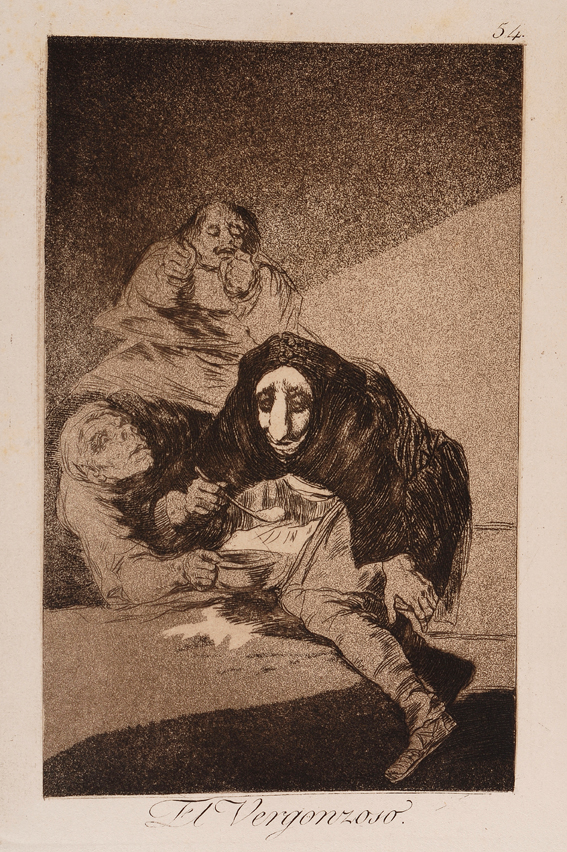
Etching and aquatint, 15 x 21,5 cm.
The interpretation of this stamp is one of the most difficult because of the erotic ambiguity he do. A man with a phallic nose (a friar?) is eating a white soup that is offered by another one at the same height of the sex. The Biblioteca Nacional and Ayala’s manuscripts make veiled reference to the erotic theme of the stamp. However, the Prado says: “Hay hombres cuya cara es lo más indecente de todo su cuerpo y sería bien que los que la tienen tan desgraciada y ridícula se la metieran en los calzones.” (Translation: there are any men whose face is the most indecent of his body and it would be nice if those who her so miserable and ridiculous would put her in their pants.)
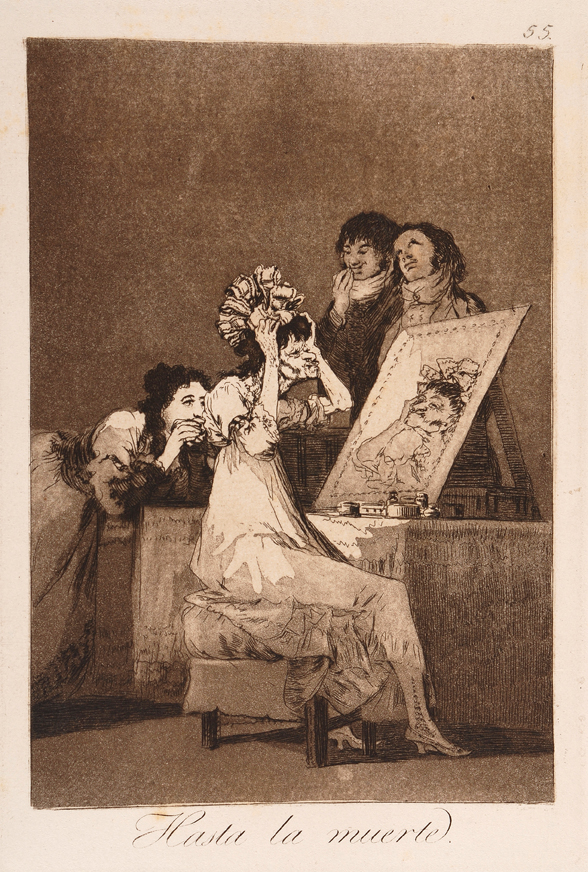
Etching, aquatint and drypoint, 15 x 21,5 cm.
It’s a ruthless satire of feminine vanity and coquettish. The Prado’s manuscript says: “Hace muy bien de ponerse guapa. Son sus días: cumple 75 años y bendrán sus amiguitas a verla.” (Translation: She does very well to look pretty. These are his days: turns 75 years old and they will come all his friends to see her).
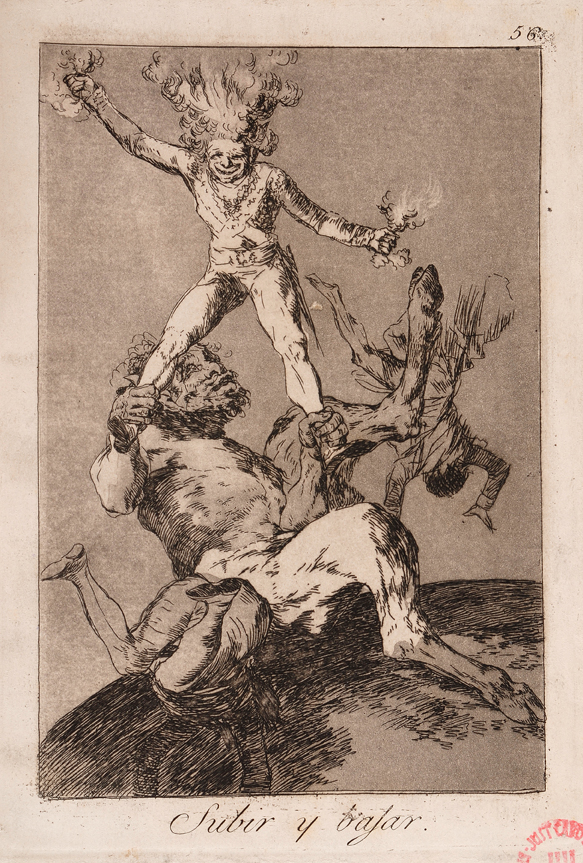
Etching and aquatint, 15 x 21,5 cm
A monstrous being, diabolical if we see his goat legs, elevates a uniformed man with this head ignited by a flame and with fire in his hands he found with the zenith of his power, while others who have gone before him fall and rush into nothingness. Everybody can read between the lines a mention to the powerful Godoy, the queen’s favorite and the king’s proxy. The Ayala’s manuscript says: “La lujuria le eleva por los pies; se le llena la cabeza de humo y viento y despide rayos contra sus émulos” (Translation: Lust lifts him up by the feet; his head is full of smoke and wind and sends lightnings to his emulous.) The Biblioteca Nacional manuscript is even more explicit: “Rueda la bola: que es la historia de los favoritos.” (Translation: roll the ball: it’s the favorite’s story).
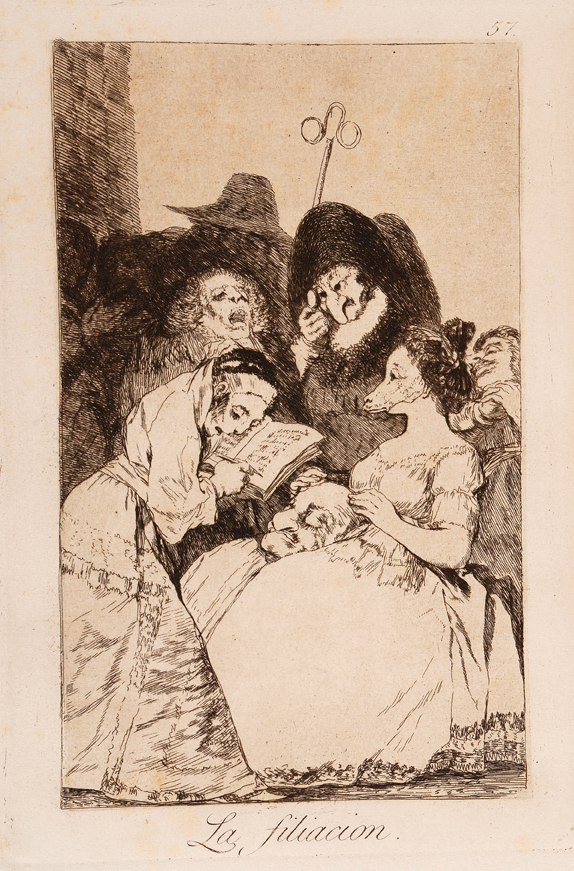
Etching and aquatint, 15 x 21,5 cm.
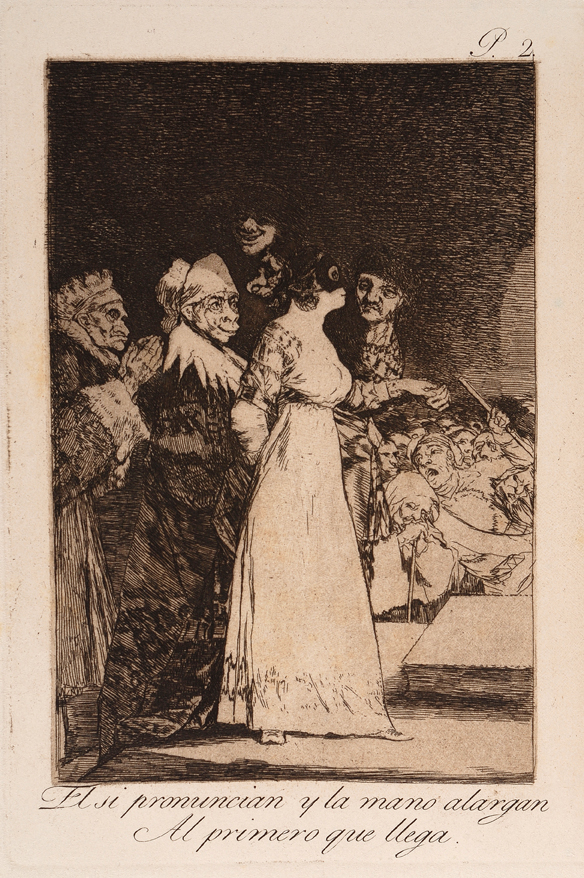
It’s another satire against the convenience matrimony, but here isn't the woman who pretends take advantage from his rich and old husband, but the old husband that don’t know who comes into his house. The Ayala’s manuscript explains the scene: “Se engatusa el novio con la Executoria de su padre, abuelos y tatarabuelos. ¿Y ella quién es? Luego lo verá” (Translation: the groom is ensnared with the fathers, grandfather and great-grandfathers executory. And who is she? Then he'll see it). The bridge has a face/fox mask to indicate her prostitute condition and caresses the horns of the male mask that presses against her womb. The old husband, despite of the monocle, doesn’t see anything strange. In the back, an assistant elevates a stick with glasses. The priest from the first term only sets the act in the wedding book.
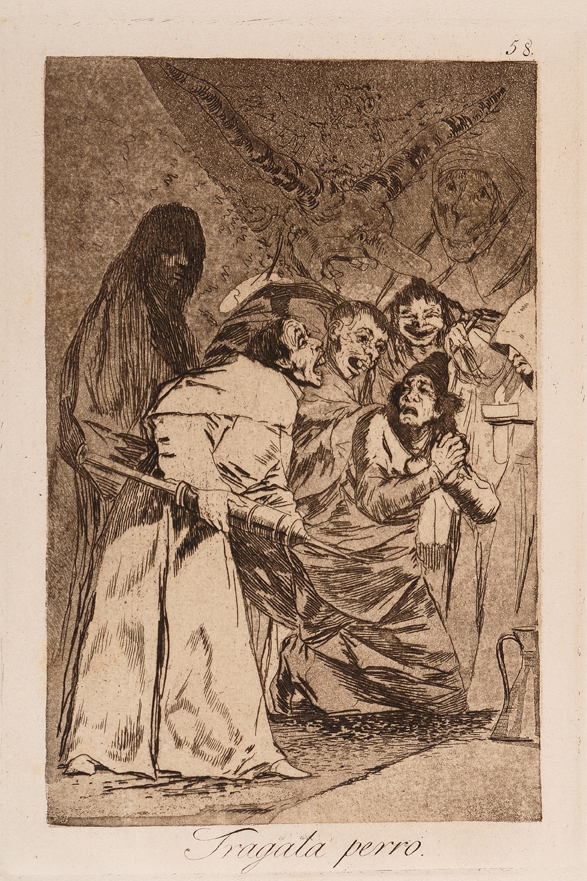
Etching, aquatint and drypoint, 15 x 21,5 cm
The title of the stamp evokes the popular song of the liberals against Fernando VII and the absolutists: “Trágala, trágala, perro. Traga la Constitución” (Translation: Swallow it, swallow it, dog. Swallow the Constitution). From the shadow a big horned monster presides the scene. In front of all we see a friar with a big syringe that was used for the enemas he was threatening to do to a poor man kneeling for mercy, surely the horned husband that must "swallow" what the corrupt and ignorant friars command. The Prado's manuscript says: “El que viva entre los hombres será geringado irremediablemente...” (Translation: who live with men will be syringed irretrievably).
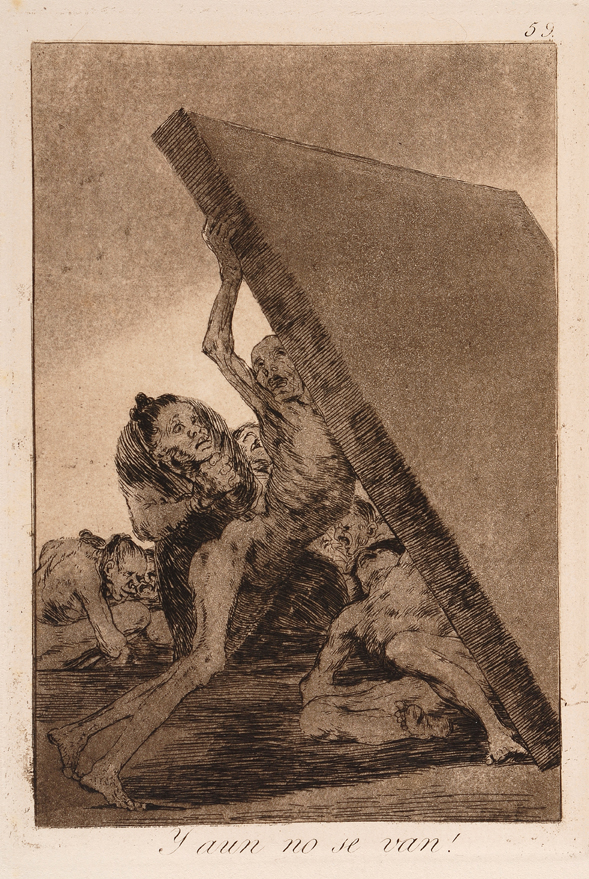
Aguafuerte y aguatinta y buril, 15 x 21,5 cm
Esta estampa es difícil de interpretar. Los comentarios manuscritos no ofrecen ninguna pista coherente. Algunos creen ver los muertos que luchan contra la losa que los quiere sepultar y que intentan sobrevivir en el recuerdo y en el enredo de intereses que dejaron al morir. Otros, en cambio, fundamentándose en el manuscrito del Prado, interpretan la escena como una manifestación de la locura humana. La gente continua haciendo sus actividades horrorosas y sin ningún sentido aunque la losa de la muerte está a punto de caer sobre ellos y que, aunque comienza a clarear en el horizonte la luz de la Ilustración, los adictos al oscurantismo todavía no se van.
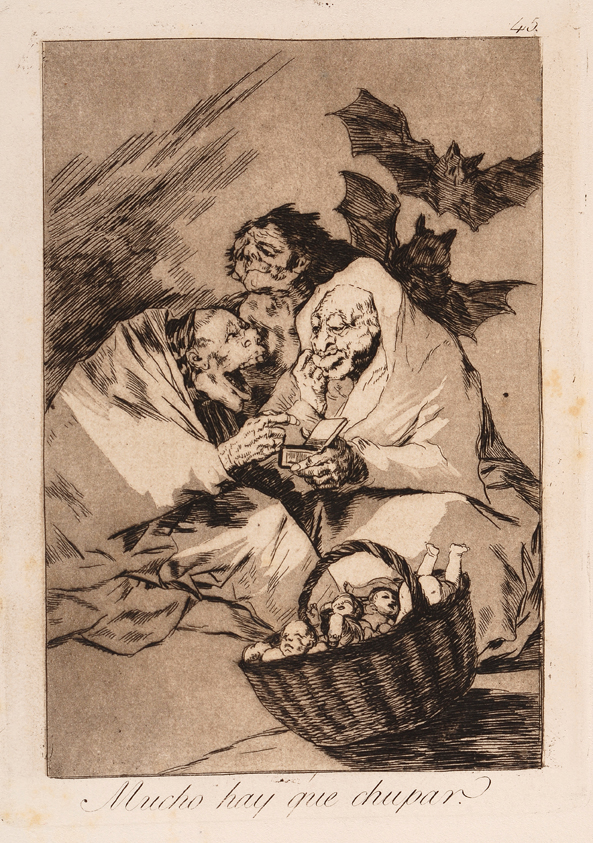
Etching and aquatint, 15 x 21,5 cm.
The etching with witch and witches’ Sabbath themes are difficult for us to understand because now we don’t know the practices and their impact in the popular mentality in Goya’s time. The Prado’s manuscript says: “Las que llegan a 80 chupan chiquillos: las que no pasan de 18 chupan a los grandes. Parece que el hombre nace y vive para ser chupado.” (Translation: Those who reach 80 suck children: those who don’t exceed 18 suck the older. Seems like the man born and live for being sucked). Seems like Goya plays with the double sense of the word suck. In one side, refers to the witches and magicians that it was said that suck the child’s blood that were kidnapped but, in other side, suck means taking advantage or parasitizing and Goya would like to report the obscurantism fanaticism that grows sucking the blood of the most vulnerable.
Aguafuerte y aguatinta y punta seca, 16,5 x 20,5 cm
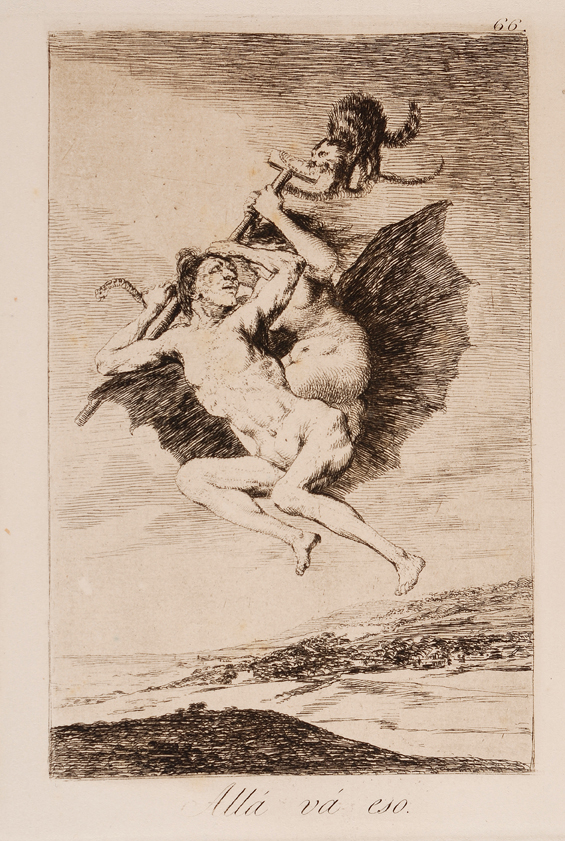
Un dibujo preparatorio de esta estampa conservado en el Prado lleva la siguiente inscripción manuscrita de Goya: “Sueño. Bruja maestra dando lecciones a su discípula del primer buelo”. El manuscrito de la Biblioteca Nacional dice: “Las viejas astutas son las que pierden a las jobenes; las echan a vola; y enseñan a ser sierpes y garduñas de los bolsillos.”
Aguafuerte, aguatinta y punta seca, 16,5 x 21 cm
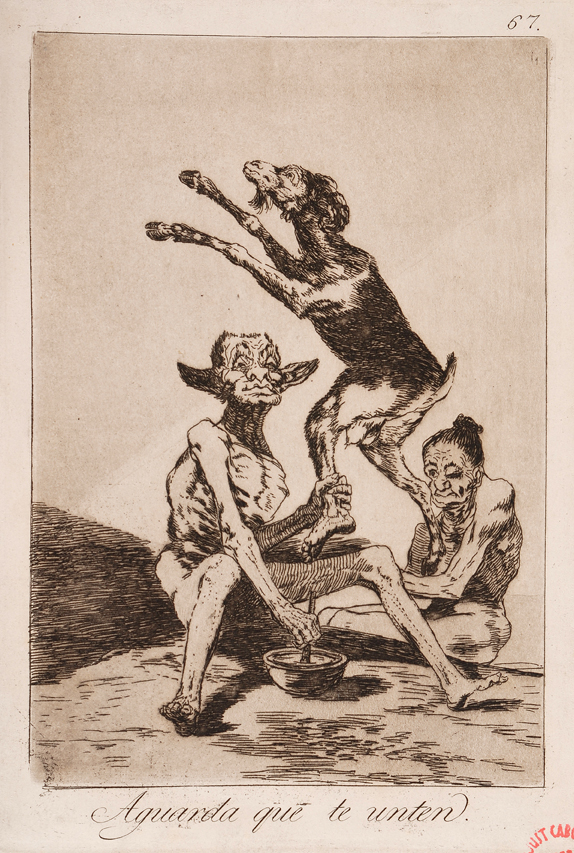
Representa un episodio de iniciación a la brujería por medio de la unción. Se trata de una metamorfosis de un ser humano en un animal. El comentario del Prado dice: “Le embían un recado de inportancia y quiere irse a medio untar. Entre los brujos los hay tanbién troneras, precipitados, botarates, sin pizca de juicio: todo el mundo es país.” El manuscrito de la Biblioteca Nacional es mucho más contundente: “Con la untura de la ignorancia y la torpeza, se convierten al fin los hombres en cabrones.” El manuscrit de Ayala es más lacónico e irreverente; titula la estampa simplemente: “La Extrema-Unción”.
Aguafuerte, aguatinta y buril, 15 x 20 cm
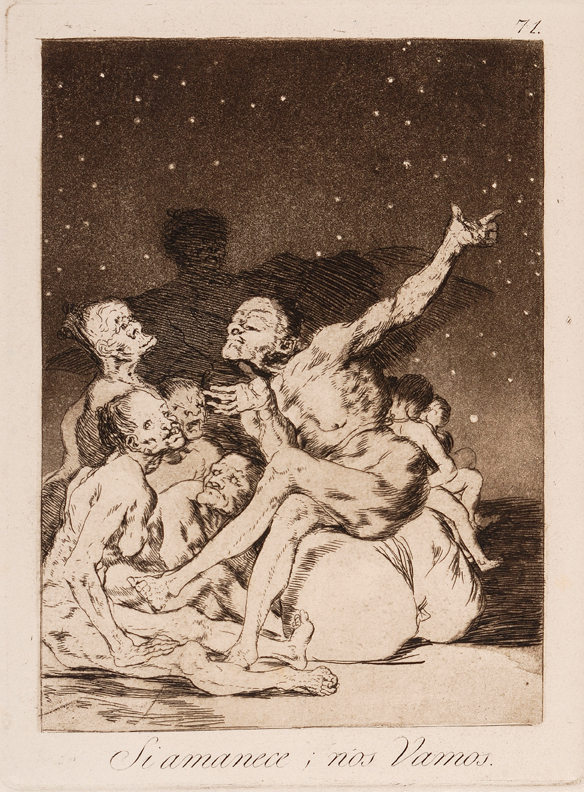
El artista juega aquí con la dialéctica entre ilustrados i oscurantistas, razón y fanatismo, luz y tinieblas. Un conciliábulo de brujas se ha reunido en la oscura noche, como es costumbre. En el horizonte empieza a insinuarse el alba. El manuscrito del Prado dice: “Y aunque no hubiérais venido, no hiciérais falta”, dando a entender que la llegada del día, de la luz de la razón y de la ciencia es ineludible y entonces el mundo caótico de la brujería, de las supersticiones, de los fantasmas y de la magia se fundirá inexorablemente por sí mismo.
Aguafuerte, aguatinta y buril, 15 x 21,5 cm
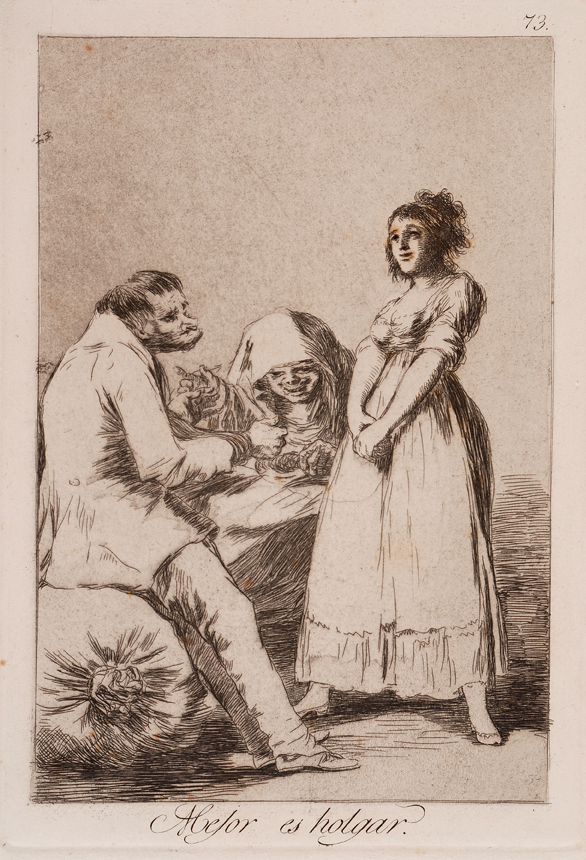
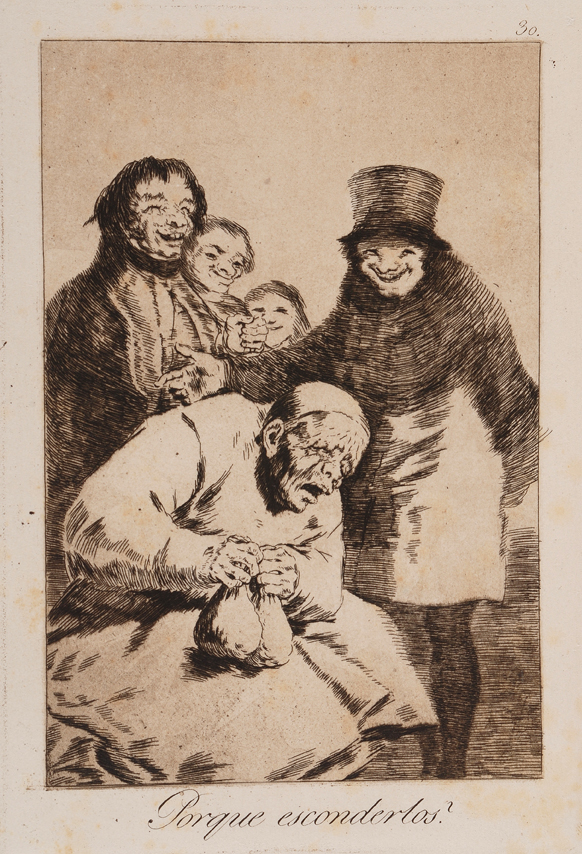
Se trata de una escena doméstica en que el artista fustiga la ociosidad de las mujeres perezosas que se casan para aprovecharse de las riquezas de un marido viejo y bobalicón. Vemos la mujer en la frescura de su edad en una posición y con un gesto insinuante mientras el marido, horroroso y atontado, se la mira sentado sobre un saco bien atado (¿de dinero?) y la madre o celestina que urdió el matrimonio sonríe contando dinero o tramando nuevos embrollos para la esposa insatisfecha.
Aguafuerte, aguatinta y buril, 15 x 20 cm
La estampa parece que alude a la falsa modestia de algunas mujeres que rechazan las propuestas amatorias pero en el fondo las desean. Un duende o fantasma, vestido de fraile, como Goya hace habitualmente, irrumpe en la vida de una buena chica. Ella opone alguna resistencia pero su sonrisa pícara hace pensar que la visita será bien recibida.
Etching, aquatint and drypoint, 15 x 19 cm.
In this stamp, Goya makes fun of compliments and blandishments that normally joins the courtship. The Biblioteca Nacional de España manuscript says: “Un casquivano cuando solicita a una mujer hace con ella las mismas muecas y zalamerías que un perrillo faldero.” (Translation: A brainless when ask for a woman do the same grimaces and sneerings as a lapdog). In second term, we can distinguish the unmistakable figure of a celestine, a Goya’s very frequently theme, which links courtship with the prolegomenon of prostitution.
Etching and aquatint, 10,5 x 20,5 cm
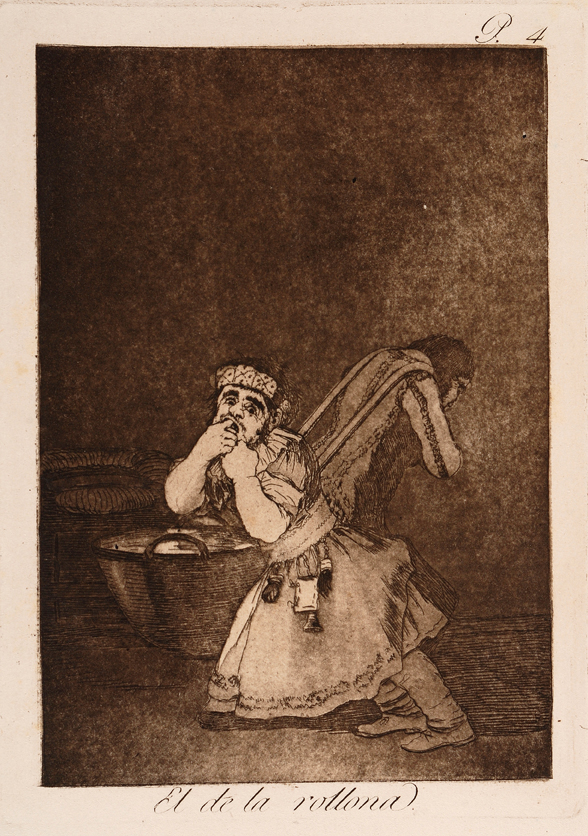
“Rollona” means babysitting. The stamps refers to an old saying: “El niño de la rollona que tiene siete años y mama aún ahora” (Traduction: Babysitting’s child that have seven years and sucks even now). The stamp show us a child that brings beard and goes with a strip that hangs amulets to avoid the evil eye. The Biblioteca Nacional manuscript comments: “Los hijos de los grandes, se atiborran de comida, se chupan el dedo y son simpre niñotes aun con barba, y así necesitan que los lacayos los lleven con andaderas” (Traduction: The sons of the olders gorges of food, thumbsucks and are always “niñotes” even with beard, for this even need that the lackeys take them with walkers).
Etching and aquatint, 15 x 20,5 cm
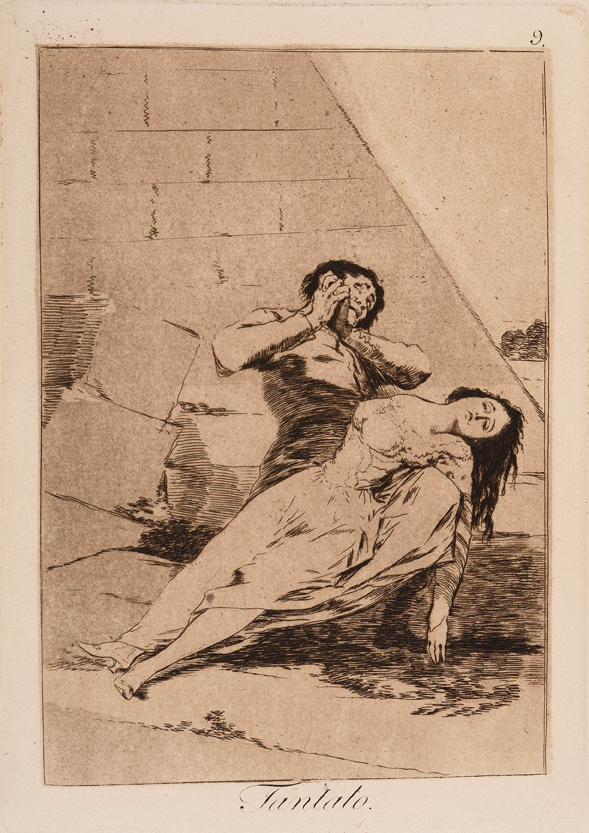
The mythical torment of Tantalus (seeing fresh water and cannot drink) is applied by Goya with ironical cruelty to the impotence of old husbans, how Moratin do in his comedies. Goya commented the stamp in this way: “Si él fuese más galán, ella reviviría. Esto sucede a los viejos que se casan con las mozas.” (Translation: If he was more gallant, she would revive. This happens to the old men who marry young ladies).
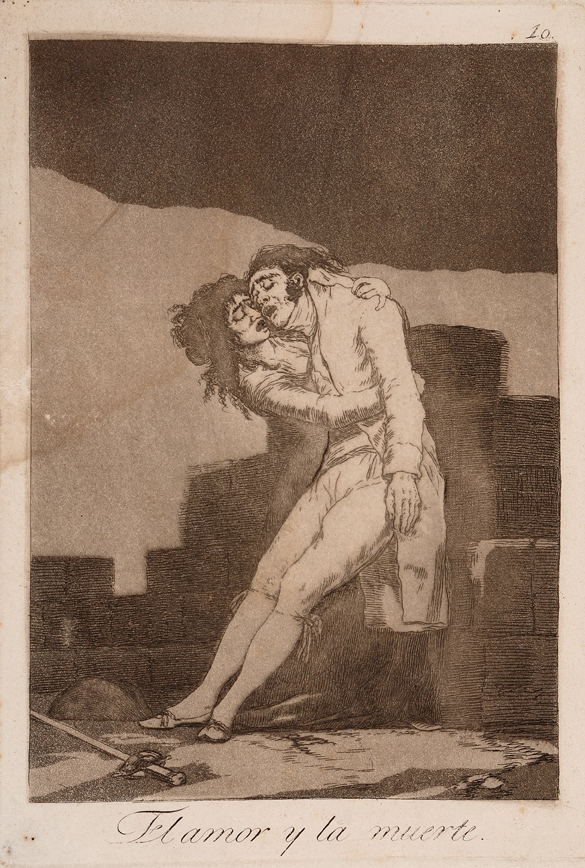
Etching and aquatint, 15 x 21,5 cm
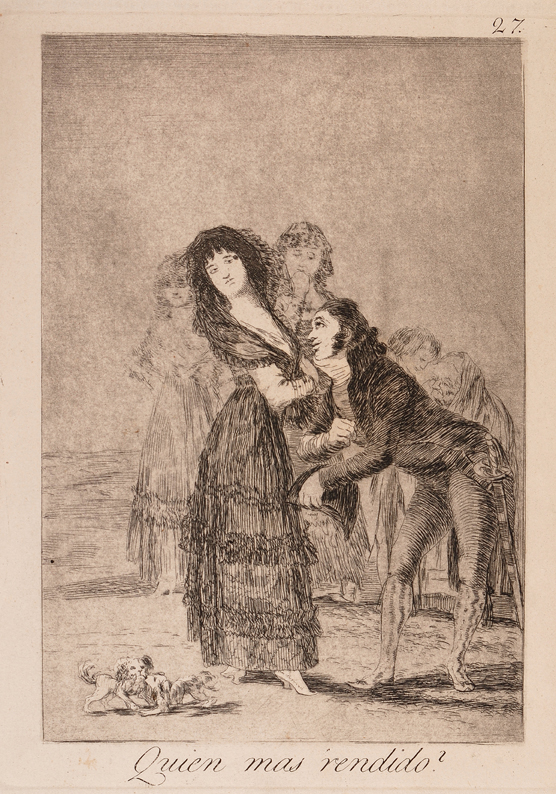
Looks like the theme is that romantic love duel. The Prado’s manuscript says: “Ve aquí un amante de Calderón que por no saberse reír de su competidor muere en brazos de su querida y la pierde por su temeridad. No conviene sacar la espada muy a menudo.” (Translation: See here a Calderon’s lover that for not knowing how to laugh at his competitor, dies in his lover’s arms and loses it for his temerity. It’s not good to draw the swoord too often).
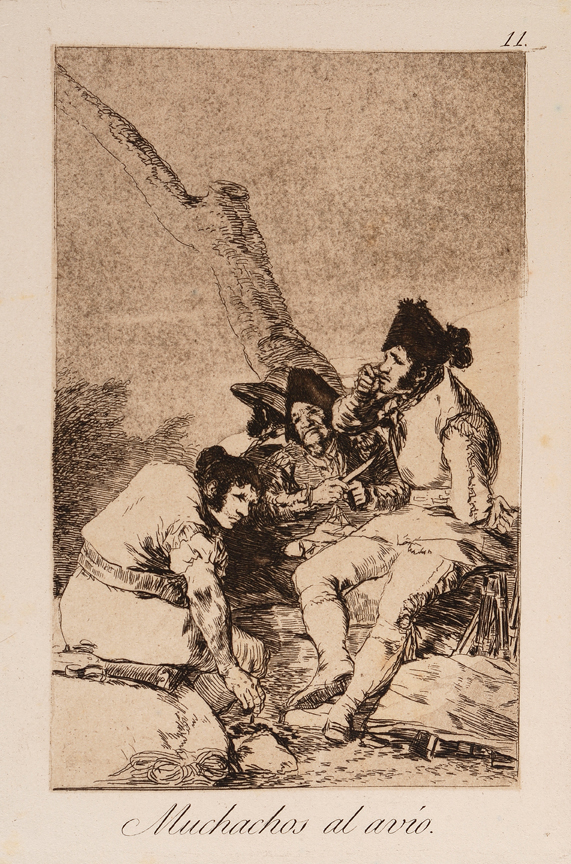
Etching, aquatint and cutter, 15 x 21.5 cm.
The Prado’s manuscript says: “Las caras y el trage están diciendo lo que ellos son” (Translation: The faces and the suit are saying that they are). Obviously it is a bandits and highway robbery’s scene, a social theme common at this time.
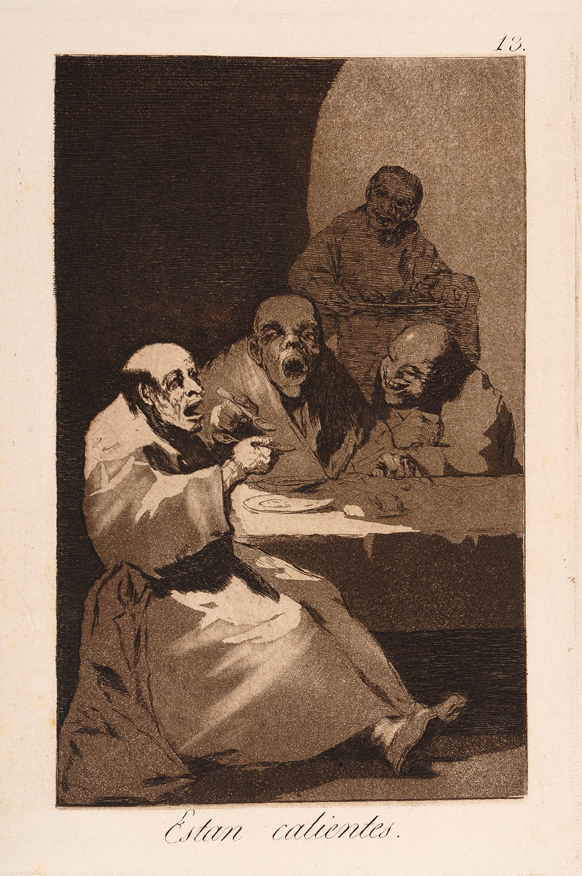
Etching and aquatint, 15 x 21.5 cm
It’s a cruel anticlerical satire. The drawings preparations with comments that are conserved in el Prado were more tough and forceful and reference the gluttony and the friars hidden lubricity. The manuscript comment of Prado says: “Tal prisa tienen de engullir que se las tragan hirbiendo. Hasta en el uso de los placeres son necesarias la templanza y la moderación.” (Translation: Such hurry have to gulp that swallows boilind. Even in the use of pleasures, temperance and moderation are necessary).
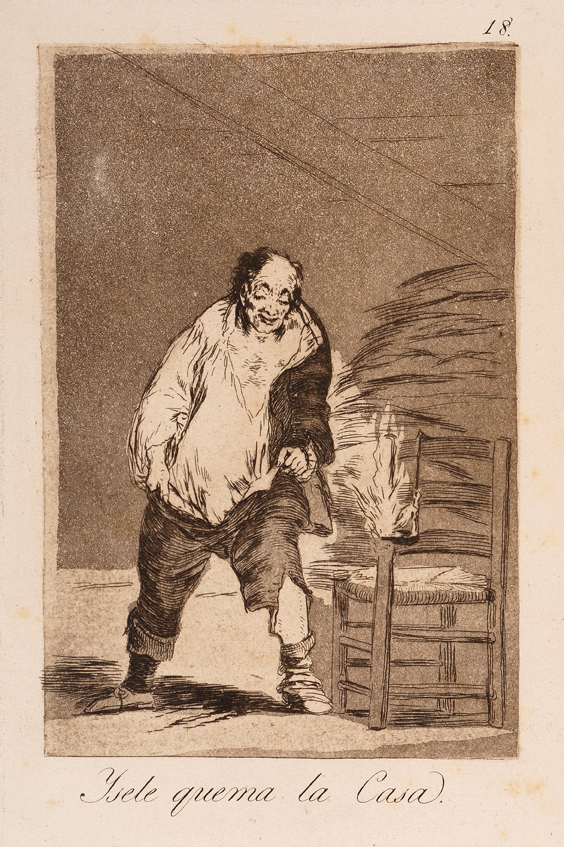
Etching and aquatint, 15 x 21,5 cm.
A preparatory drawing conserved in El Prado says: “Espartero borracho que no acierta a desnudarse y dando buenos consejos a un candil, yncendia la casa” (Translation: Drunk Espartero (who elaborates esparto grass) can’t undress himself and, doing good advices to an oi llamp, set fire to the house). The press of that time informs of fires frequently in houses and espartero’s warehouses. The Prado’s manuscript commentary says: “Ni acertará a quitarse los calzones ni dejar de hablar con el candil hasta que las bombas de la villa le refresquen. ¡Tanto puede el vino!” (Translation: Nor will he succeed in taking off his panties, nor stop talking with the oil lamp until the village’s bombs refresh him.)
Etching and aquatint, 14.5 x 21.5 cm.
It’s a satire againts the judges and partial justice. In Pan y toros already speaks of the “la fortísima flange de letrados que armados de sus plumas y cubietos de sus eternos pelucones, todo lo vencen y todo lo atropellan” (Translation: the many lawyers that armed with his feathers and cobered with his eternal bigwigs, beat and run over everything). A candid and gullible female bird falls into the hands of the insensitive judges, of leonine factions, who don’t hesitate to pluck and devour her like they do with justice. The Prado’s manuscript says: “También las Pollas encuentran milanos que las despluman y aun por eso se dijo aquello de: Donde las dan las toman.” (Translation: Also the pullets finds kites who pluck them and that’s why it was said that about: what goes around comes around).
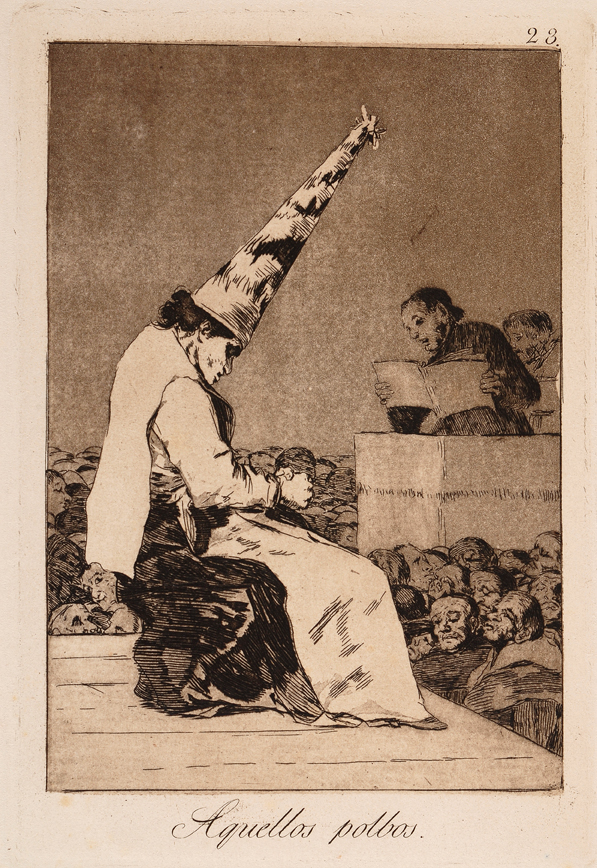
Etching and aquating, drypoint and burin, 15 x 21.5 cm.
This Inquisition stamp has two different interpretations. One is a version of aphorism “Aquellos polvos trajeron estos lodos” (Translation: Those powders brought these sludge). For the illustrated minds of the time the inquisitorial faith acts are the paradigm of obscurantist fanaticism that nurtured superstitious fear of a degraded society. The Ayala’s manuscript describes the stamp in this way: “Auto de fe. Un vulgo de curas y frailes necios hacen comidilla de semejantes funciones. Perico el cojo que daba polvos a los enamorados” (Translation: Auto faith, a commonplace of priests and foolish friars make “comidilla” of similar functions. “Perico el cojo" (the lame) who gave dust to lovers).
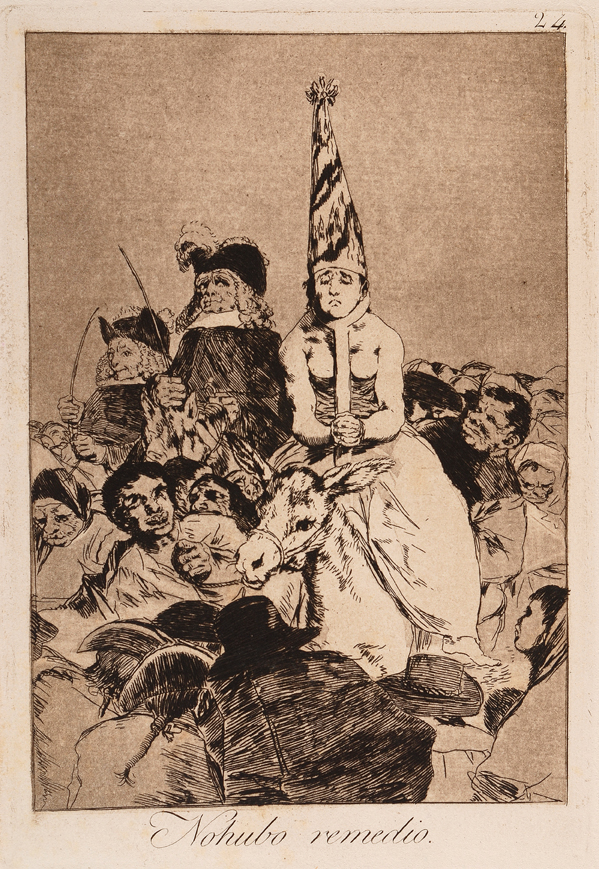
Etching and aquatint, 15 x 21.5 cm.
The interpretation of this stamp has the same problem than the last. In Prado’s manuscript text, Goya even injuries at the condemned woman: “Si lo hacen para afrentarla es tiempo perdido. Nadie puede avergonzar a quien no tiene vergüenza” (Translation: If they do it to deal with it, it’s wasted time. No one can shame who have no shame). The text from the Ayala’s manuscript is very forceful and is more agree with the Goya’s liberals thoughts: “Es pobre y fea ¿cómo habría de haber remedio?" (Translation: She is poor and ugly “How could there be any remedy?), what can say is that with Money and sext the condemned situation could have been reversed.
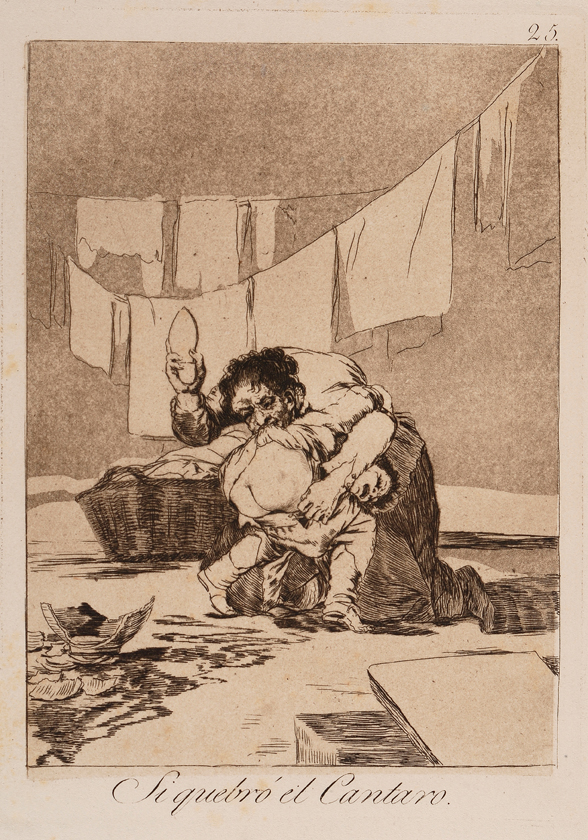
Etching, aquating and drypoint, 15 x 21.5 cm.
Seems like a simple popular street scene, but denotes a strong condemntation of violence in children’s education. In Prado’s manuscript, Goya wrote: “El hijo es travieso y la madre colérica ¿Qual es peor?” (Translation: The son is naughty and the mother choleric. Who is worse?).Etching and aquatint, 15 x 21,5 cm
It’s a satire of the marriage of convenience motivated by interest and deception. The Prado’s manuscripts says: Facilidad con que muchas mugeres se prestan a celebra matrimonio esperando vivir en él con más libertad (Translation: Ease with which many womens lend themself to celebrate marriage hoping to live in it with more freedom).
Etching, aquatint and burin, 15 x 21.5 cm.
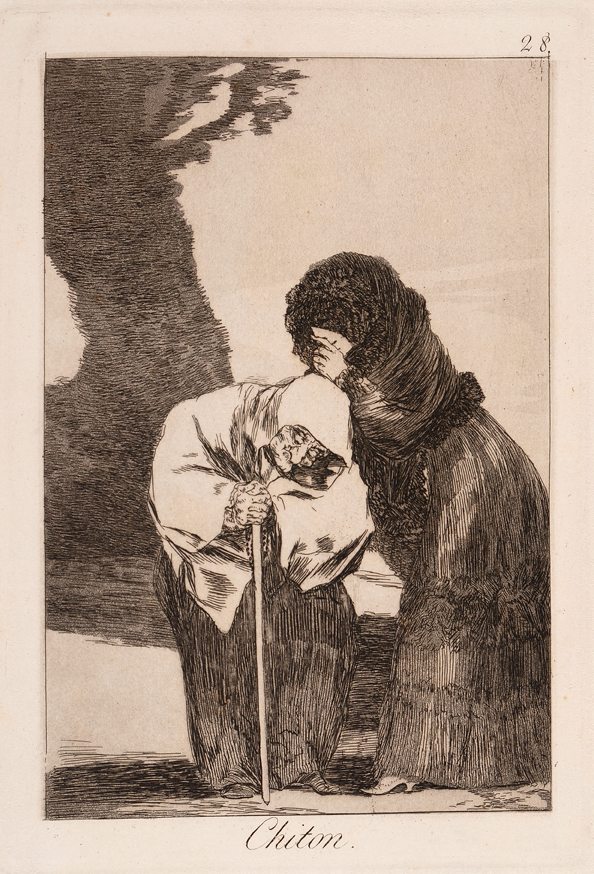
It’s another celestinesque scene. The Prado’s manuscript describes the stamp like this: “Excelente madre para un encargo de confianza” (Translation: Excellent mother for a confidence assignment). A distinguished lady, wrapped up in a shawl to not be recognized, requires services of mediation of an accomplice. This, like see Celestina, take airs of devotional recollection with the rosary clearly visible in his hands. Goya wants to make evident the hypocrite corruption of the powerful and the appearance of piety to cover it.
Etching and aquatint, drypoint and burin, 15 x 21.5 cm.
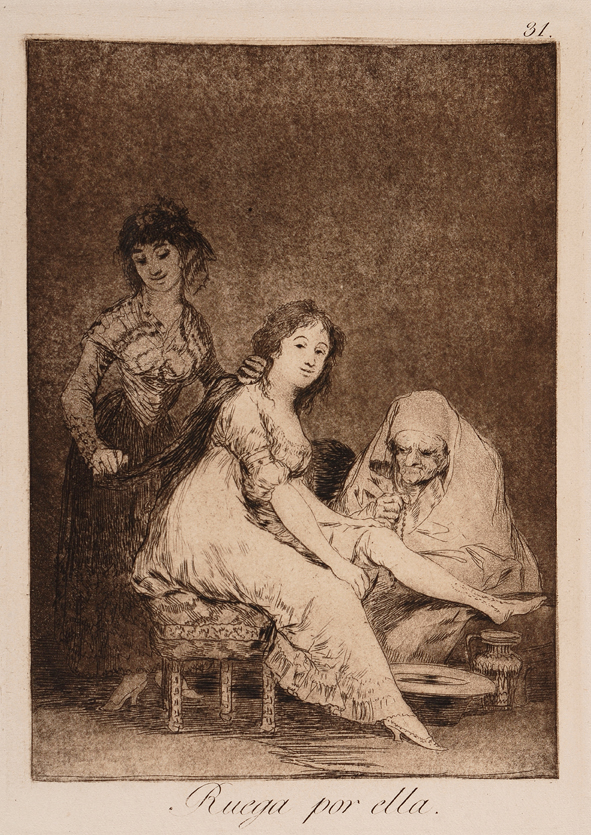
Here comes the Celestine’s theme and the whore who grooms and climbs up the stocking suggestively while the maid combs his long hair. The procuress watch his merchandise while passes the rosary. The Prado’s manuscript says: “Y hace muy bien, para que Dios la dé fortuna y la libre de mal y de cirujanos y alguaciles y llegue a ser tan diestra, tan despejada y tan para todo como su madre, que en gloria esté. (Translation: And do very well, so that God will give her fortune and set her free from the evil and surgeons and constables and become so right, so cleared and so for all like his mother, that may be in glory).
Etching and aquatint, drypoint and burin, 15 x 21.5 cm.
Here comes the Celestine’s theme and the whore who grooms and climbs up the stocking suggestively while the maid combs his long hair. The procuress watch his merchandise while passes the rosary. The Prado’s manuscript says: “Y hace muy bien, para que Dios la dé fortuna y la libre de mal y de cirujanos y alguaciles y llegue a ser tan diestra, tan despejada y tan para todo como su madre, que en gloria esté. (Translation: And do very well, so that God will give her fortune and set her free from the evil and surgeons and constables and become so right, so cleared and so for all like his mother, that may be in glory).
Etching and aquatint, 15 x 21.5 cm.
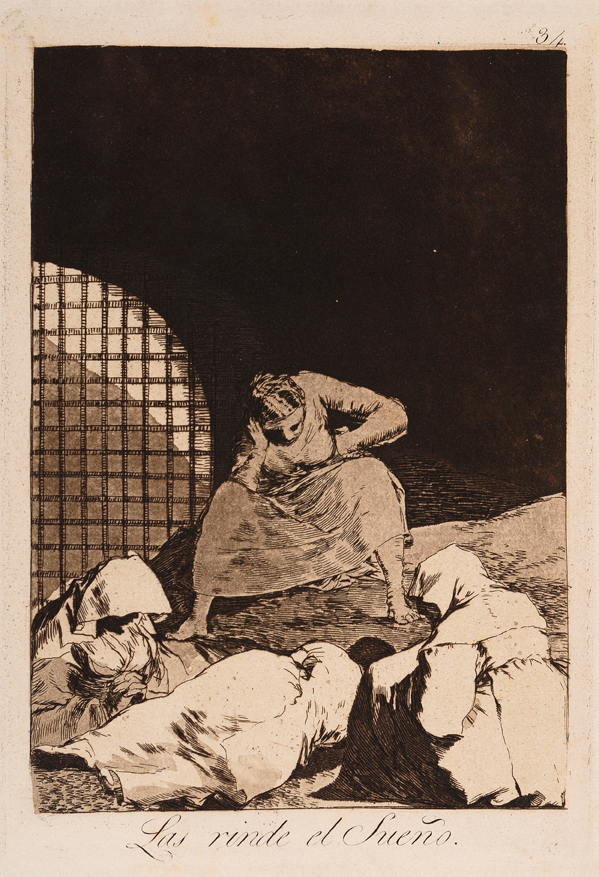
Also this stamp carries two divergent interpretations. The Prado’s manuscript considers that the scene takes place in a jail and says: “No hay que despertarlas, tal vez el sueño es la única felicidad de los desdichados”. (Translation: Don’t wake them up, maybe the dream is the only happiness of unfortunates). But if we analyze the scene we realize that the figures represent two friars with his caps and two women that are in a convent interior, probably in front of the gate of a locutorium. The genuine interpretation surely is the one with anticlerical character that we found in other manuscripts: “¿Qué han de hacer sino dormir los frailes y monjas despues de borrachos y estragado allá en sus conventos?” (Translation: What they must to do but sleep the friars and monks after drunks and straggled in his convents?).
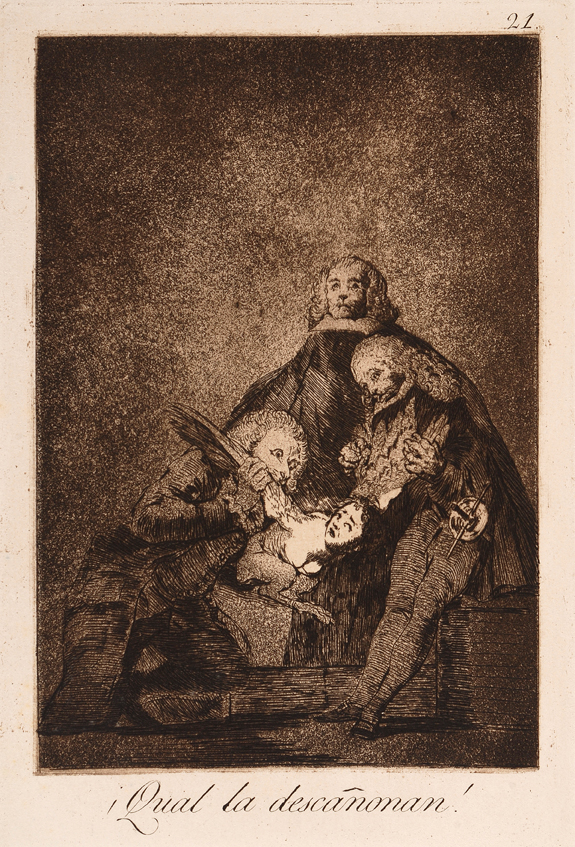
Etching and aquatint, 15 x 21.5 cm.
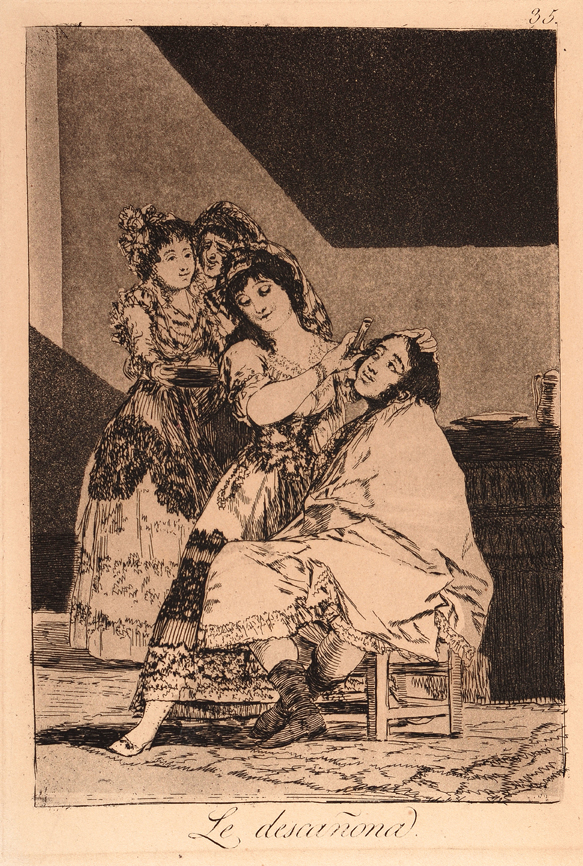
Here comes the satire to the reckless and naive men who, ensnared by the tempting woman’s Sting, they end up being cheated and plucked. The Prado’s manuscrit says: “Les descañonan y le desollarán. La culpa tiene quien se pone en manos de tal Barbero” (Translation: They will pluck and flay. The guilt comes from who puts himself in the hands of such a barber.)
Etching and aquatint, 15 x 21,5 cm.
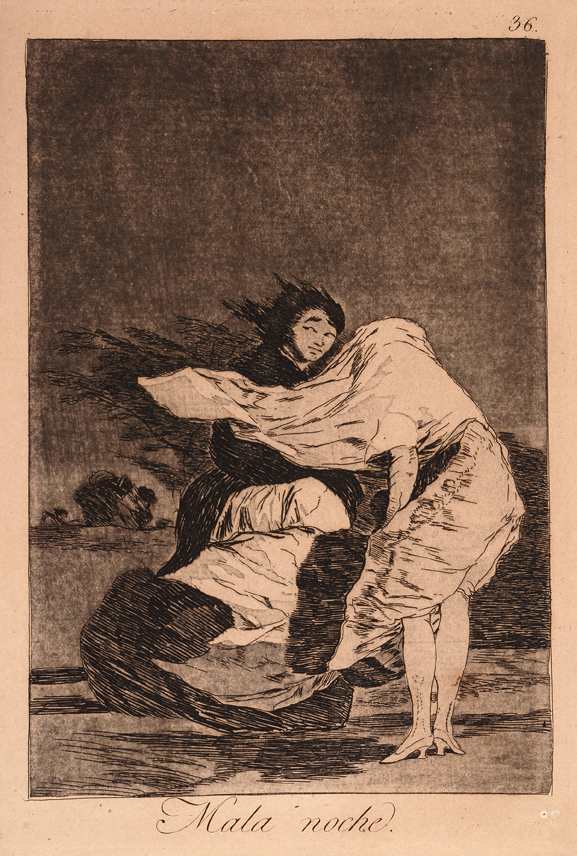
The stamp’s theme is once again the revulsion of the prostitution in the street. The many notes of Goya about the preparatory draws are full of irony. One of them says: “Si ay culpa en la escena la tiene el trage”. (Translation: if there is any guilt in the scene, the suit has it). The Prado’s manuscrit, always more moralizing than the others, sentence: “A esto trabajos se esponen las niñas pindongas que no quieren estar en casa.” (Translation: to these Works are exposed the gadabout girls who don’t want to be home). Another note reflects sharper the scene: “Malo anda el negocio, cuando el viento y no el dinero levanta las sayas a las buenas mozas.” (Translation: Bad goes the business, when the wind and not the money lift up the skirts to the good girls).
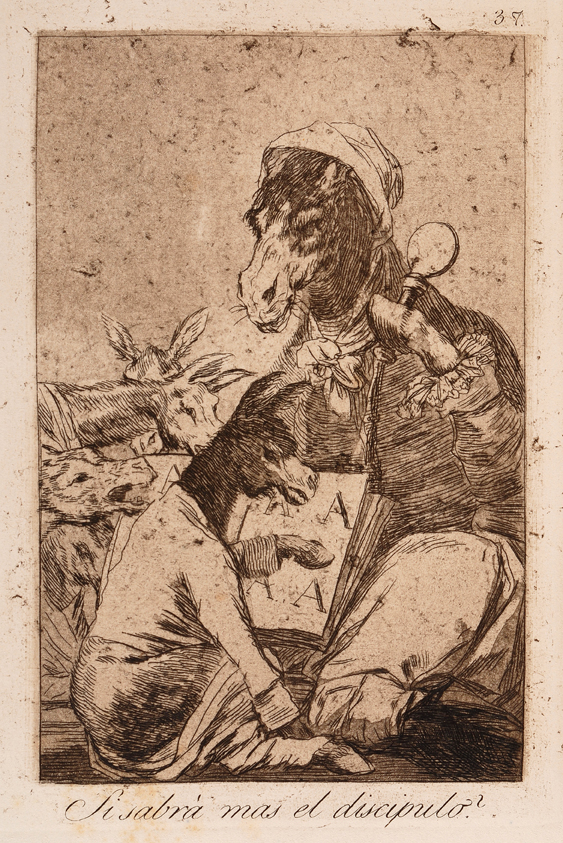
In illustrated circles were very common the jokes and reproaches to the traditional education. The Biblioteca Nacional de España manuscript says: “Un maestro burro no puede enseñar más que a rebuznar”. (Translation: a donkey teacher can teach nothing but braying). The background of the scene could be the anecdote of “Fray Gerundio de Campazas”, master of P.Isla, well known by Goya, in that the master teaches to the disciples the vocals, saying that they are called like that because they are pronounced by mouth, and the disciple asks to the pretentious teacher where the consonants are pronounced.
Etching and aquatint, 15 x 21,5 cm.
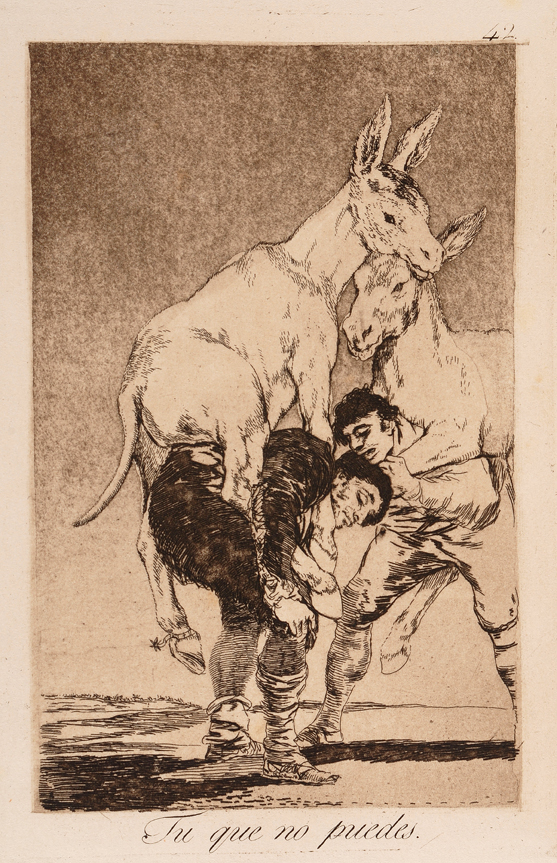
The etching is inspired in the popular saying “tú que no puedes, llévame a cuestas” (Translation: You who can’t, carry me on your back) and wants to report the unfair Distribution of social charges weighed down on the shoulders of workers, while the opulent and idle classes are free by the multitude of privilegis and exemptions. Oftentimes Goya personify powerful like donkeys. The Prado’s manuscrit have the legend: : “¿Quién no dirá que estos dos caballeros son caballerías?”(Translate: Who would say these two gentlemen are chivalries?).
Modal title
Modal text