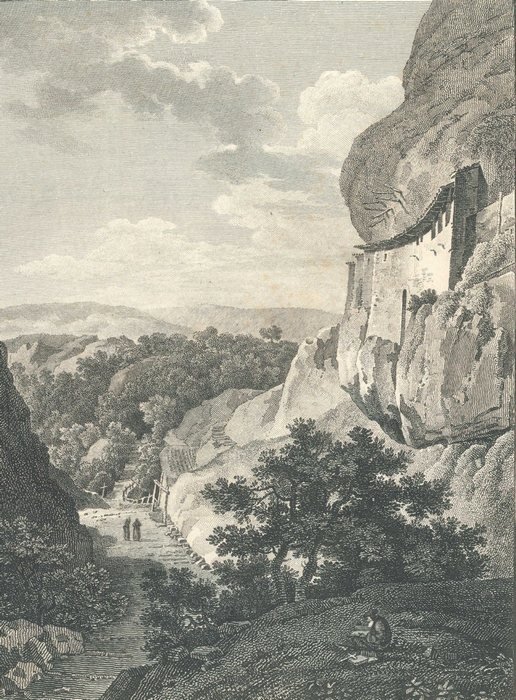
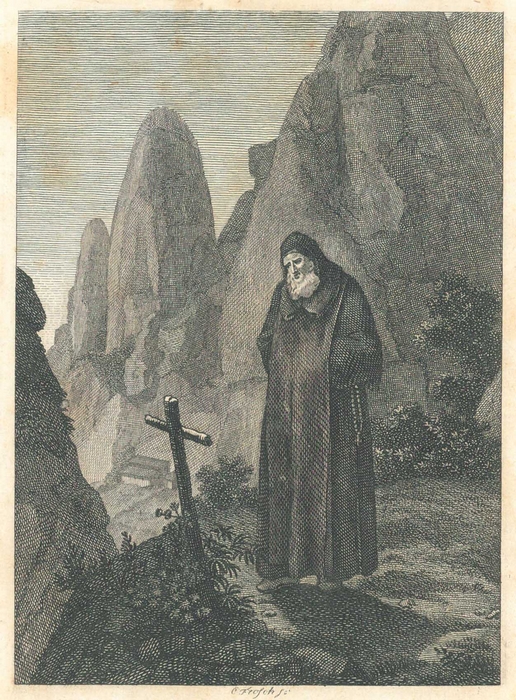
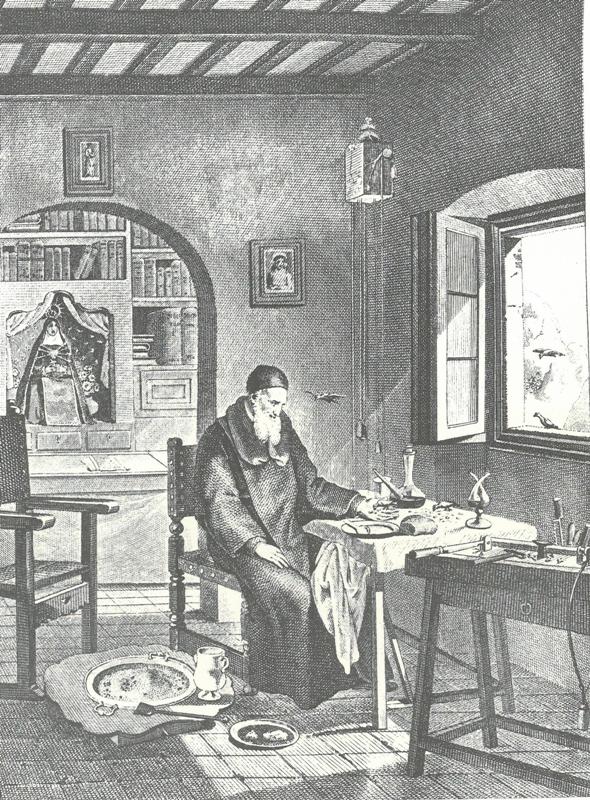
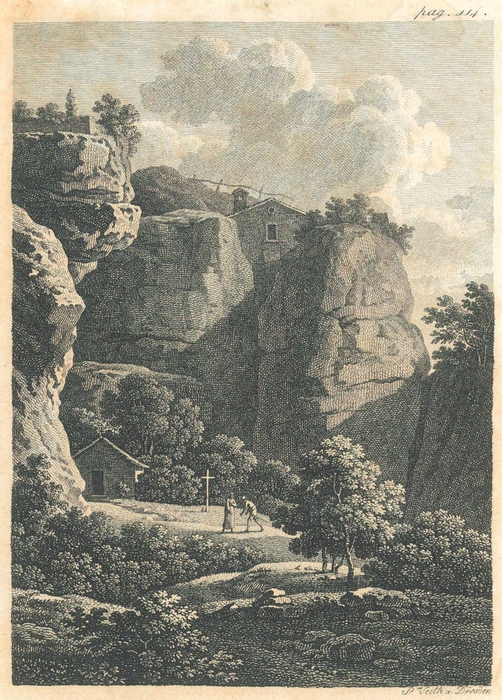
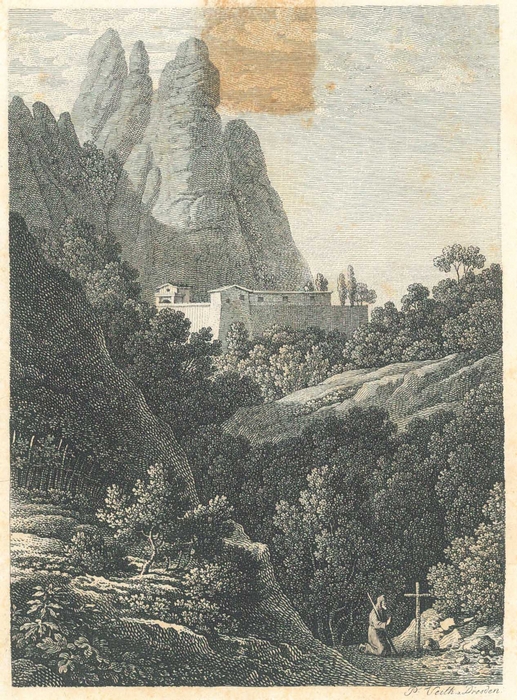
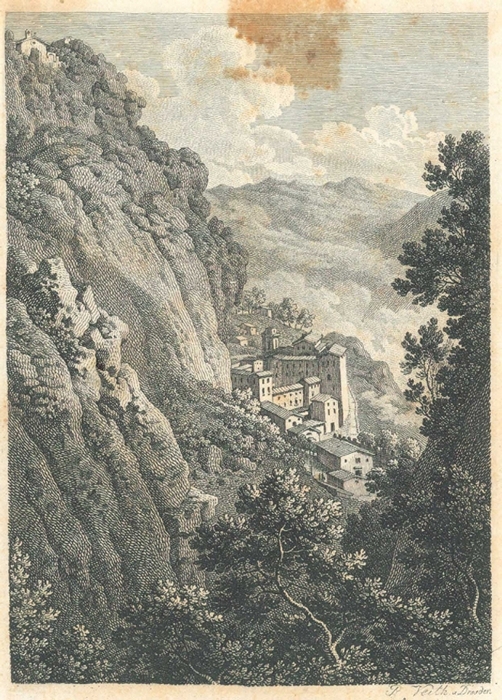
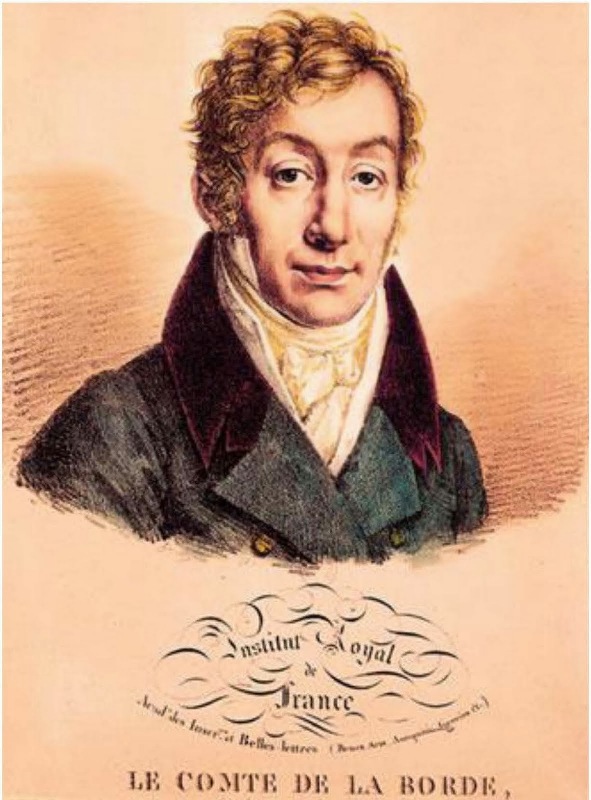
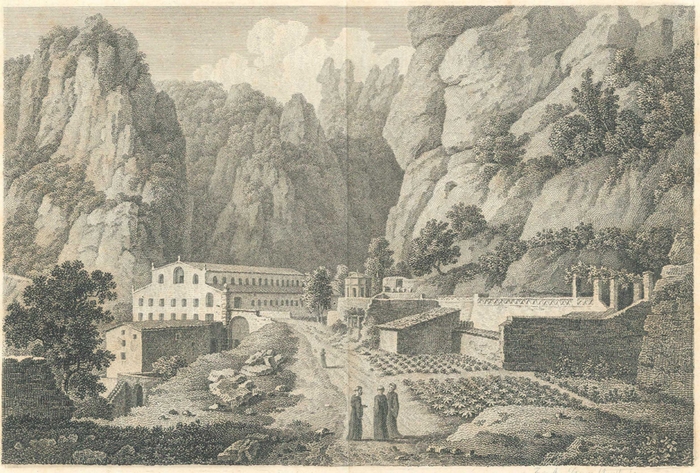
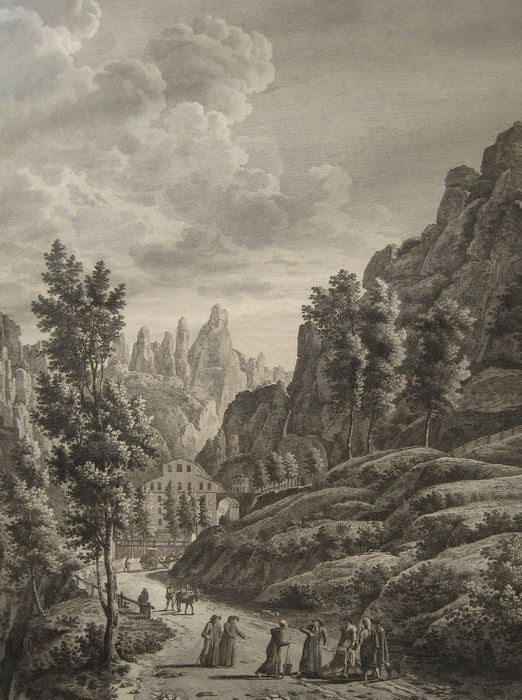
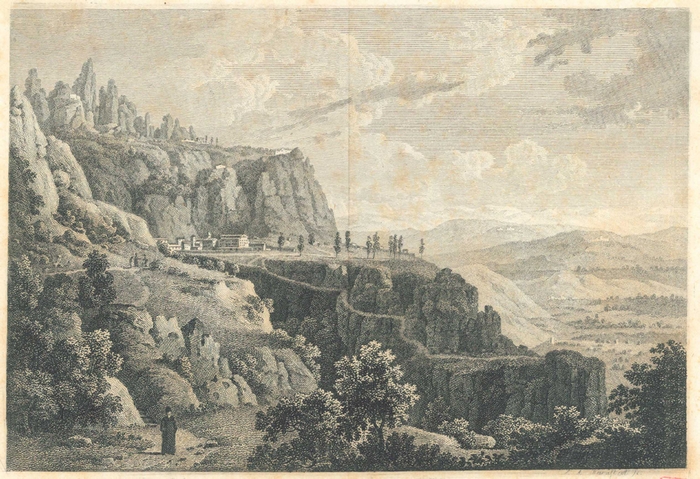
Louis-Joseph-Alexandre de Laborde (Paris, 1773-1842) was a multifaceted and exceptional figure who lived his life as a constant improvisation. He was a soldier, diplomat, civil administrator, deputy, economist, mayor, but above all a scholar, artist, archaeologist, and historian. In 1792, his father, who was banker to Louis XVI, was guillotined, and his mother and sister were imprisoned. Alexandre, who was studying in Vienna at the time, managed to escape. Under those circumstances he began his numerous travels, during which, as he noted himself, he visited Catalonia for the first time. In 1797 he was able to return to France and secured the protection of Lucien Bonaparte, with whom he moved to Madrid between 1800 and 1803 as an embassy attaché. During this time he traveled throughout Spain with a team of draughtsmen who produced a multitude of drawings that would later serve as the basis for the prints in his Voyage pittoresque en Espagne, published in four volumes by the Paris press of Pierre Didot between 1807 and 1818. Emperor Napoleon attached Laborde to his retinue as an expert on Spanish affairs when he visited Madrid in 1808; Laborde's wife was appointed lady-in-waiting to Empress Joséphine, and he himself, serving as a Councillor of State, received the title of imperial count. A few months later, the Peninsular War broke out in Spain, and as far as Montserrat was concerned, almost everything Laborde had had drawn was reduced to rubble and ruins by the French troops commanded by General Suchet.
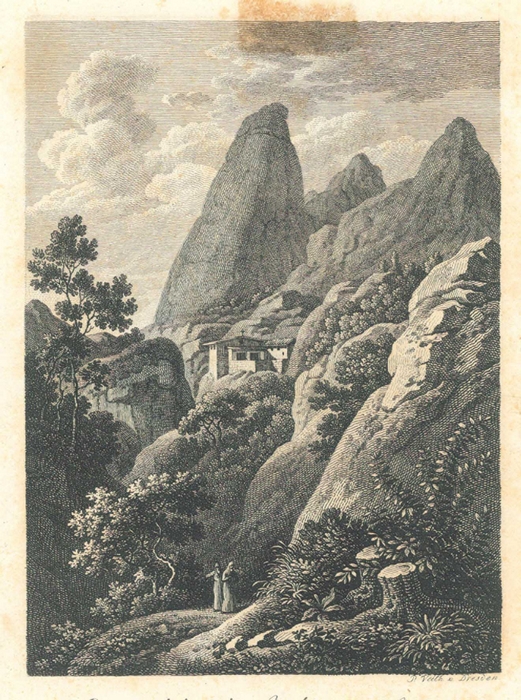
https://montserrat.sobrevia.net/arxiu_montserrat/museu/img/imgTxtGenerals/vista-de-l’ermita-de-santa-anna-S_1_1814.jpg
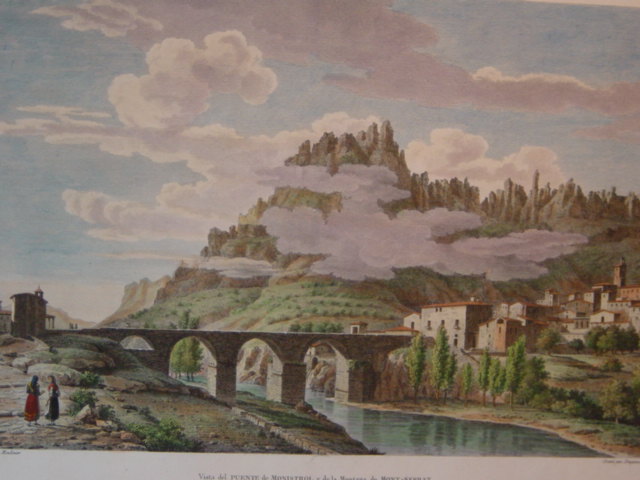
https://montserrat.sobrevia.net/arxiu_montserrat/museu/img/imgTxtGenerals/vista-del-pont-de-monistrol-i-de-la-muntanya-de-montserrat-S_1_1823.jpg
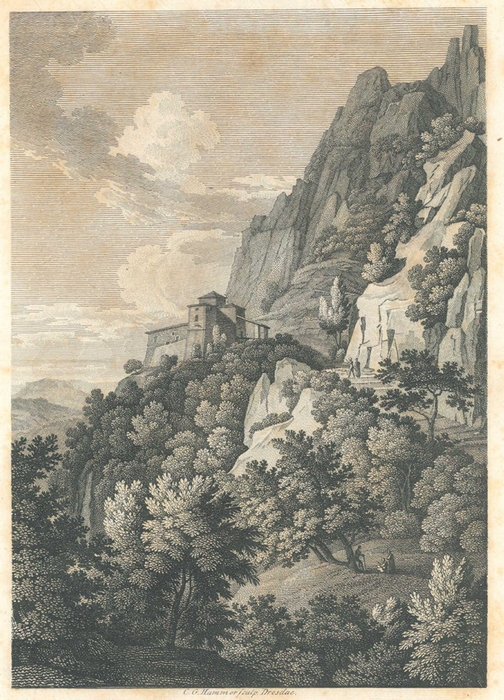
https://montserrat.sobrevia.net/arxiu_montserrat/museu/img/imgTxtGenerals/vista-de-l’ermita-de-sant-benet-S_1_1822.jpg
https://montserrat.sobrevia.net/arxiu_montserrat/museu/img/imgTxtGenerals/vista-de-la-cova-de-la-verge-de-montserrat-S_1_1821.jpg
https://montserrat.sobrevia.net/arxiu_montserrat/museu/img/imgTxtGenerals/ermita-de-sant-onofre-S_1_1820.jpg
https://montserrat.sobrevia.net/arxiu_montserrat/museu/img/imgTxtGenerals/ermita-en-meditacio-S_1_1819.jpg
https://montserrat.sobrevia.net/arxiu_montserrat/museu/img/imgTxtGenerals/interior-de-l’ermita-de-sant-dimes-S_1_1818.jpg
https://montserrat.sobrevia.net/arxiu_montserrat/museu/img/imgTxtGenerals/ermita-de-sant-dimes-S_1_1817.jpg
https://montserrat.sobrevia.net/arxiu_montserrat/museu/img/imgTxtGenerals/ermita-de-la-santissima-trinitat-S_1_1816.jpg
https://montserrat.sobrevia.net/arxiu_montserrat/museu/img/imgTxtGenerals/vista-del-monestir-presa-des-de-la-muntanya-S_1_1815.jpg
Alexandre de Laborde
https://montserrat.sobrevia.net/arxiu_montserrat/museu/img/imgTxtGenerals/alexandre-de-laborde-S_1_1804.jpg
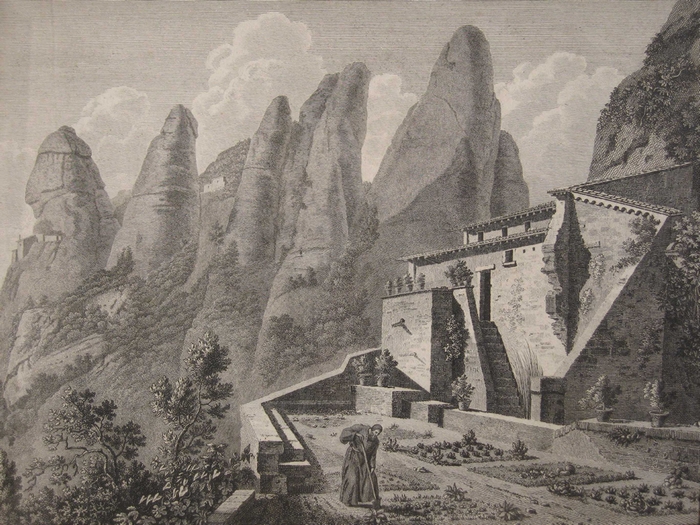
View of Montserrat garden
Plate XXV. Drawing by Dutailly (Lyon, doc. 1790-1803...), etching by Jean Desaulx (ca. 1750-1819) and finished by Lienard.
Laborde comments this stamp saying that the true garden of the Monastery is “the mountain itself, as there is nothing more beautiful that what nature wanted to embellish.” The image allows us to see the surface of Montserrat church before the 19th century apses were added. Laborde call it "garden", but it was actually a vegetable orchard.
https://montserrat.sobrevia.net/arxiu_montserrat/museu/img/imgTxtGenerals/vista-del-jardi-de-montserrat-S_1_1813.jpg
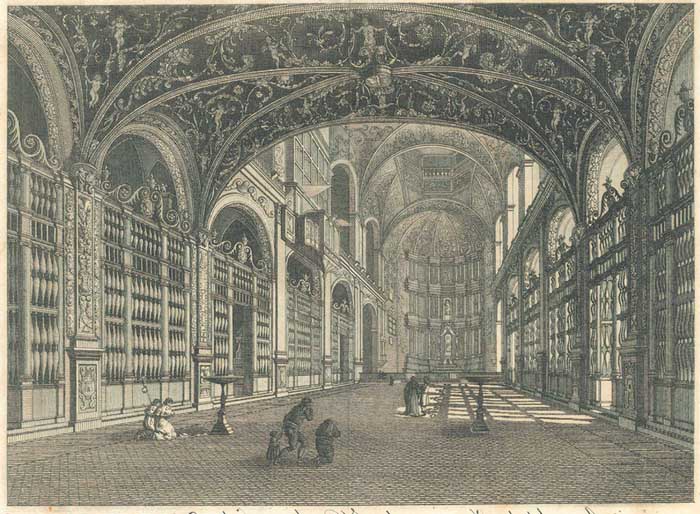
View of Montserrat church
Plate XXIV. Drawing by François Ligier (ca. 1755-1803...), etching by Jean Baptiste Réville (Paris, 1767-1825) and finished by M.-A. Benoist (1768-1826).
This is another engraving of great importance for the history of Montserrat, since it presents a view of how it was inside the church before it was burned by Napoleon's troops in 1811. Laborde explains that the drawing has dispensed the large grille separating the altar so we can see well the whole church with its Renaissance altarpiece by Esteban Jordan, 1593. And above all, it allows us to see the 1669 decoration with "golden arabesque" that covered the interior of the church and caused the admiration of Laborde.
https://montserrat.sobrevia.net/arxiu_montserrat/museu/img/imgTxtGenerals/vista-de-l’esglesia-de-montserrat-S_1_1824.jpg
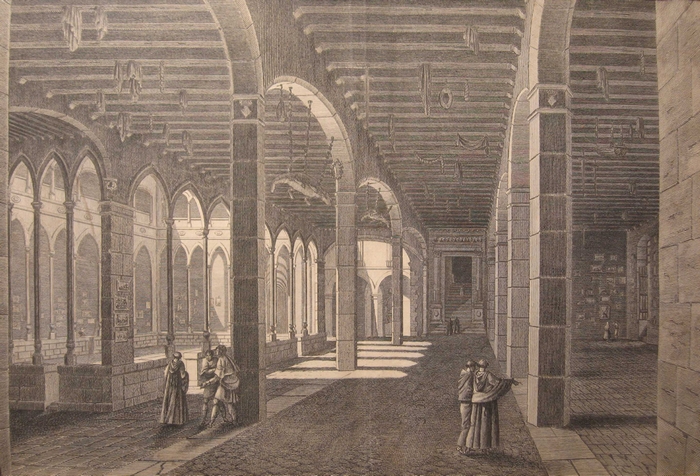
Main cloister of the Monastery
Plate XXII. Drawing by François Ligier (c. 1755-1803...), etching by Emilien Desmaisons (Paris, doc. 1770-1834) and finished by M.-A. Benoist (1768-1826).
This stamp is the only graphic testimony of the old Gothic cloister, in 1476, joined by the east side to the big porches of reduced arches that were built by prior Ramon de Vilaragut (1334-1348). In the middle, at background, we can see an entrance to the monastery and on the left the communication with the atrium of the church, which was a recent work of the late eighteenth century. But the most curious thing in this stamp are the votive offerings hanging in this area: small altarpieces, shrouds, ship models and Amazon alligators.
https://montserrat.sobrevia.net/arxiu_montserrat/museu/img/imgTxtGenerals/claustre-principal-del-monestir-S_1_1811.jpg
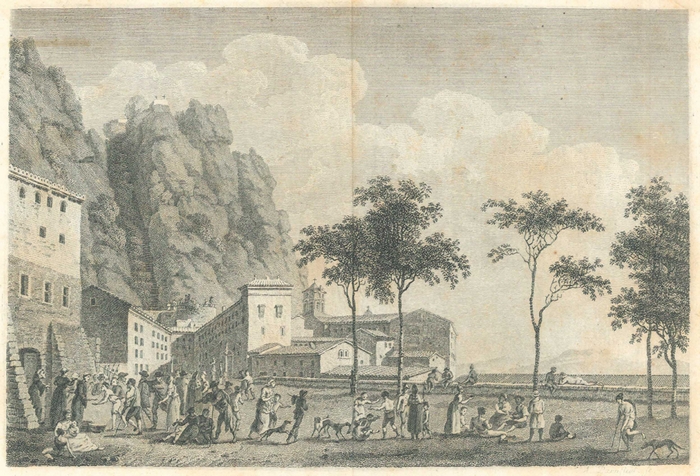
View of the entrance to the Monastery and the Hospital of Montserrat
Plate XXII. Drawing by François Ligier (ca. 1755-1803...), engraved by FB Lorieux.
Laborde describes the distribution of Montserrat buildings: the church with the bell tower in the background, the convent and other rooms of the monastery, the door leading to the steep stairs that climb on a channel of the mountain and leads to different hermitages and, to the left, leaning against the rock, the buildings intended to house the pilgrims. The one in the first term is the hospital of the poor at the time of distributing the noon soup.
https://montserrat.sobrevia.net/arxiu_montserrat/museu/img/imgTxtGenerals/vista-de-l’entrada-del-monestir-i-de-l’hospital-de-montserrat-S_1_1810.jpg
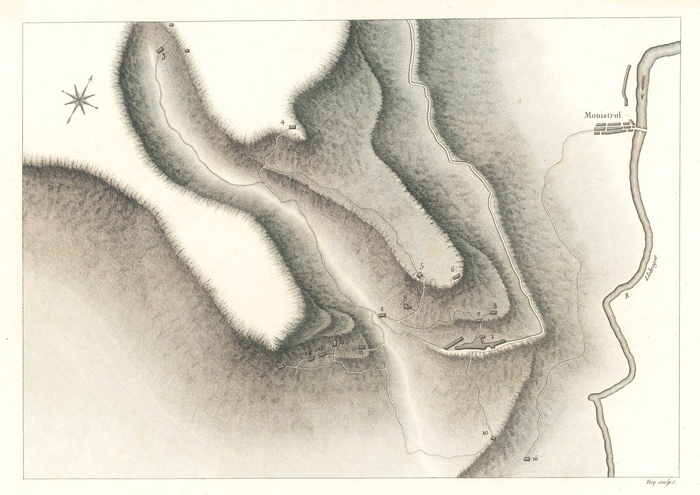
Respective positions of the hermitages and the Monastery of Montserrat
Plate XXI. Engraving by Adrien Vicq.
The map is not made to scale and seems rather a scheme made without instruments that an orographic work. It’s useful to provide an idea of the location of the monastery overlooking to Llobregat River and leaving the village of Monistrol back. It indicates the two access roads and the branch to visit the hermitages, with the churches of Sant Miquel and the Cave of the Virgin.
https://montserrat.sobrevia.net/arxiu_montserrat/museu/img/imgTxtGenerals/situacio-respectiva-de-les-ermites-i-del-monestir-de-montserrat-S_1_1809.jpg
Entrance to the Monastery by the carriages road
Plate XX. Drawing by Jacques Moulinier (Montpellier, 1753-1828), engraved by Louis Garreau.
The road of Sant Miquel, which left from Collbató and joined Montserrat with the royal road Lleida-Barcelona, has always been a bridlepath; it was the shortest one but also the most rugged, so that when the monastery grew and bustle carriage was required, they had to enable the northern one that linked Montserrat with the royal road by Can Massana’s way. The arrival at Montserrat by this side is not as spectacular as the one offered by Sant Miquel road. We only see the back of the church with the bridge linking the monastery and the garden. Laborde presents the scene of some monks who have left for a walk and they assist a devotee who has made the indiscreet promise of visiting the Virgin kneeling.
https://montserrat.sobrevia.net/arxiu_montserrat/museu/img/imgTxtGenerals/entrada-al-monestir-pel-cami-dels-carruatges-S_1_1808.jpg
General view of the mountain and the Monastery of Montserrat
Plate XIX. Drawing by Jacques Moulinier (Montpellier, 1753-1828), engraved by Claude-François Fortier (1775-1836).
Laborde describes the bridlepath from Collbató to Montserrat. He explains how the procession stopped at the chapel of Sant Miquel and the overview of the monastery that he watched from there. Laborde took note surprisingly accurate of that vision: the monastery buildings, with the garden and the hermitage of Sant Iscle; the nearest lofty mountain chapels, the path of the Cave and the Plain of the Witches; in the background, farming fields in Llobregat Valley.
https://montserrat.sobrevia.net/arxiu_montserrat/museu/img/imgTxtGenerals/vista-general-de-la-muntanya-i-del-monestir-de-montserrat-S_1_1807.jpg
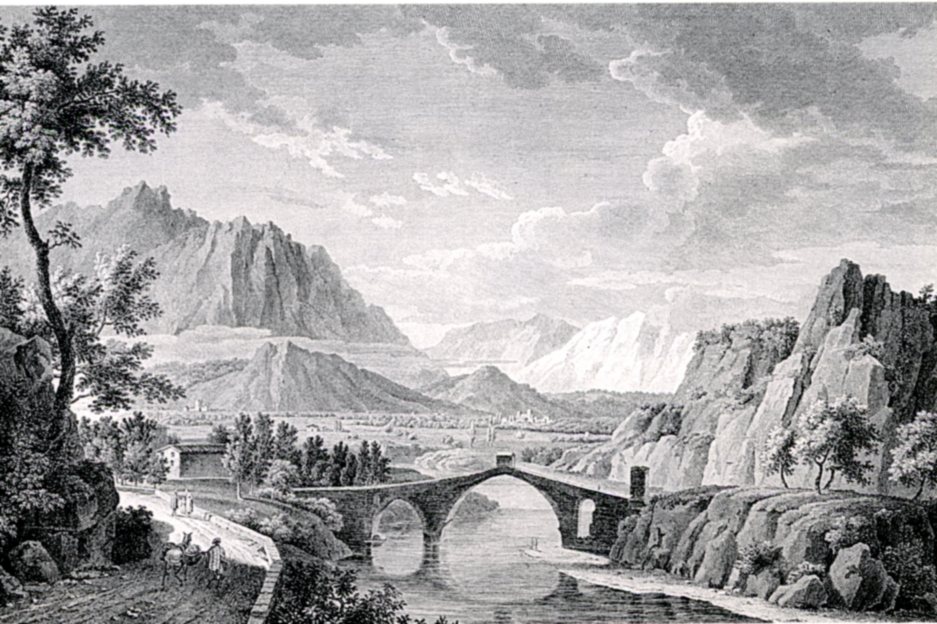
Views of Martorell Bridge and the mountain of Montserrat
Plate XVI. Drawing by Jacques Moulinier (Montpellier, 1753-1828), engraved by François-Nicolas Dequevauviller (1745-1807).
Martorell was often the place where travellers stayed overnight before taking the way up to Montserrat, which started in Collbató. Laborde explains how to get to Montserrat from Barcelona and the which was his experience when he saw the silhouette of the mountain from the Roman Bridge, with its triumphal arch.
https://montserrat.sobrevia.net/arxiu_montserrat/museu/img/imgTxtGenerals/vista-del-pont-de-martorell-i-de-la-muntanya-de-montserrat-S_1_1806.jpg
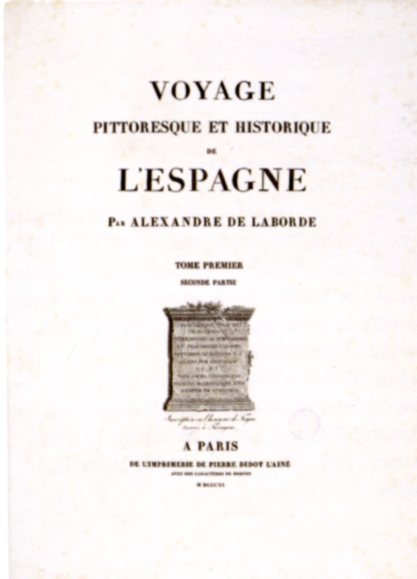
Frontispiece of the first volume of the 'Voyage pittoresque'
It contains the Introduction and historical notes on the first eighty-eight plates. Edited with Bodoni typeface in the workshops of Pierre Didot l'Aine in Paris between 1806 and 1820.
https://montserrat.sobrevia.net/arxiu_montserrat/museu/img/imgTxtGenerals/frontispici-del-primer-volum-del-voyage-pintoresque-S_1_1805.jpg